
Loading article…
Landskrona Citadel (Swedish: Citadellet or Landskrona slott) is situated in Landskrona, Scania, southern Sweden. Much of the original work is intact. Examples remain of all major parts of the fortification, which is uncommon in such an accessible area. The moat around the central fortification is intact, as are the north-west and north-east parts of the outermost moat, which originally connected to a moat surrounding the city itself. Centermost, the citadel sits on an island surrounded by its own moat.[1] North of the fort, between the second, third and fourth moat is Sweden's oldest allotment-garden. Several of its garden houses are attractions in themselves.[2] Also the fortress castle itself hides both history as such as well as historical horrors, like the 16th Century dungeon in the old western tower, into which the unlucky prisoners were thrown down through a hatch. If surviving the 4-5 meter fall, there then was neither any daylight or any way out. Also the eastern tower has in later centuries served as a prison for those serving life sentences.[3] Around 1900 until 1940 a part of the fortress served as a forced labour institution for vagrant women[4][5] After the Second World War, from May 1945, surviving Jews from Nazi German concentration camps were treated at the Citadel. They came with the Red Cross buses, locally known as "the White Buses".[6]
Initially built by Christian III of Denmark[7] 1549–1559 as a purely defensive fortification with two complete moats, the inner with a width of 70 metres (230 ft). The outer (complete) moat is between 40 and 70 metres (130 and 230 ft) wide, and has cross firebastions for artillery and guns. Outside the outer moat, a third narrower moat covers the northwest and northeast. There also exist remains of a fourth moat (between the two outer moats). The fortifications and moats system surrounding the castle is known to be one of Europe's largest and best preserved. In the area between the outer and far outer moat resides the oldest area of allotment-garden cottages of Sweden.
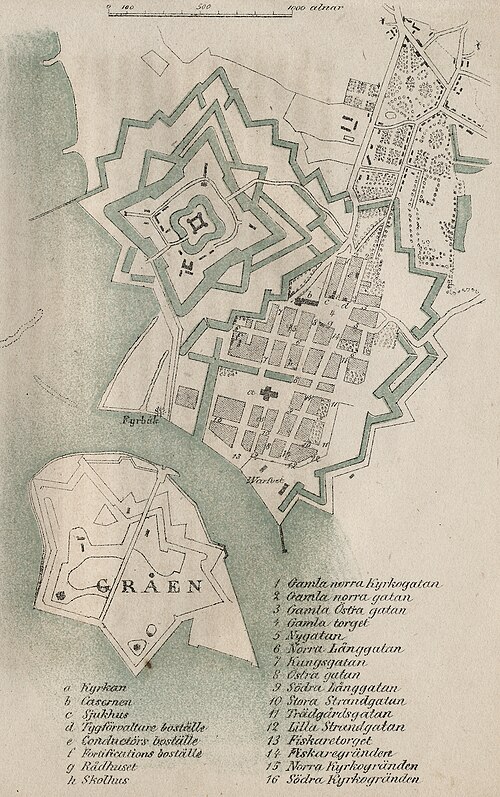
1644年にスウェーデン軍に一時的に占領されたが、すぐに放棄され、再びデンマークに返還された。1658年のロスキレ条約の結果、スウェーデン国王の所有となった。1667年から1675年にかけて、城塞は大規模な稜堡によって拡張された。1676年8月2日、スコーネ戦争中に、司令官ヒエロニムス・リンデベリは城とともにデンマーク軍部隊に降伏した。そして1676年から1679年にかけて、この城はスコーネ義勇軍(デンマーク・スコーネ史では「Friskydter」、スウェーデンでは「Snapphanar」)の指揮センターとして使用され、正規のデンマーク軍とともにスウェーデン占領軍と戦った。リンデベリはデンマーク軍から生き延びたが、後にスウェーデン国王カール11世(「カール11世」)の命令により処刑された。
18世紀半ば、地元の軍司令官は、当時スコーネ地方で2番目に大きかった15世紀の教会、サンクティ・ヨハニス・バプティスタエ・キルカ(「洗礼者ヨハネ教会」)を(突如として)破壊しなければならないと恐れました。その理由は、教会の塔に敵の大砲が設置されていることへの懸念でした。教会全体が取り壊され、数十年後に新しいソフィア・アルベルティーナ教会が建てられました。城は19世紀後半から数十年後にかけて、女子刑務所として使用されました。現在、城は一種の博物館(ガイド付きツアーのみ、ただし料金は安く、夏季は毎日開催)として利用されているほか、プライベートパーティーのために貸し出すこともできます。