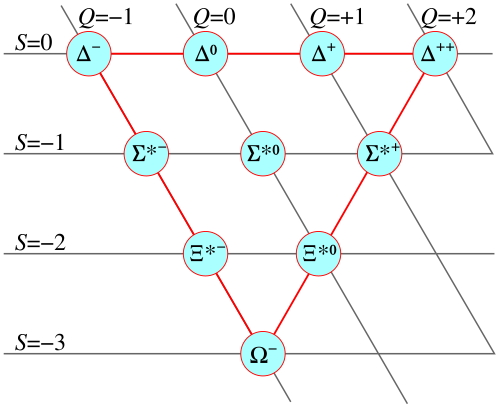
励起ハイペロン共鳴と、表記に「*」が含まれる基底状態ハイペロンは、強い相互作用を介して崩壊する。Ω − as well as the lighter hyperons this decay mode is not possible given the particle masses and the conservation of flavor and isospin necessary in strong interactions. Instead, these decay weakly with non-conserved parity. An exception to this is the Σ0 which decays electromagnetically into Λ on account of carrying the same flavor quantum numbers. The type of interaction through which these decays occur determine the average lifetime, which is why weakly decaying hyperons are significantly more long-lived than those that decay through strong or electromagnetic interactions.[7]
Ω − has a baryon number of +1 and hypercharge of −2, giving it strangeness of −3. It takes multiple flavor-changing weak decays for it to decay into a proton or neutron. Murray Gell-Mann's and Yuval Ne'eman's SU(3) model (sometimes called the Eightfold Way) predicted this hyperon's existence, mass and that it will only undergo weak decay processes. Experimental evidence for its existence was discovered in 1964 at Brookhaven National Laboratory. Further examples of its formation and observation using particle accelerators confirmed the SU(3) model.
↑Greiner, Walter (2001). "Structure of vacuum and elementary matter: from superheavies via hypermatter to antimatter.". In Arias, J.M.; Lozano, M. (eds.). An Advanced Course in Modern Nuclear Physics. Lecture Notes in Physics. Vol.581. pp.316–342. doi:10.1007/3-540-44620-6_11. ISBN978-3-540-42409-3.
↑Tolos, L.; Fabbietti, L. (May 2020). "Strangeness in nuclei and neutron stars". Progress in Particle and Nuclear Physics. 112 103770: 41. arXiv:2002.09223. Bibcode:2020PrPNP.11203770T. doi:10.1016/j.ppnp.2020.103770. S2CID211252559.
↑Degrange, Bernard; Fontaine, Gérard; Fleury, Patrick (2013). "Tracking Louis Leprince-Ringuet's contributions to cosmic-ray physics". Physics Today. 66 (6): 8. Bibcode:2013PhT....66f...8D. doi:10.1063/PT.3.1989. ISSN0031-9228.
↑Ravel, Olivier (2013). Ormes, Jonathan F. (ed.). Early cosmic ray research in France. Centenary Symposium 2012: Discovery of Cosmic Rays. AIP Conference Proceedings. Vol.1516. Denver, United States: American Institute of Physics. pp.67–71. Bibcode:2013AIPC.1516...67R. doi:10.1063/1.4792542. ISBN978-0-7354-1137-1.
↑J.W. Cronin (2011). "The 1953 Cosmic Ray Conference at Bagnères de Bigorre: the Birth of Sub Atomic Physics". The European Physical Journal H. 36 (2): 183–201. arXiv:1111.5338. Bibcode:2011EPJH...36..183C. doi:10.1140/epjh/e2011-20014-4. S2CID119105540. See in particular Fig. 5.
↑Martin, B. R. (2017). Particle physics (Fourthed.). Chichester, West Sussex, United Kingdom. ISBN978-1-118-91190-7.{{cite book}}: CS1 maint: location missing publisher (link)
↑"Particle Data Groups: 2006 Review of Particle Physics – Lambda"(PDF). Archived from the original(PDF) on 2008-09-10. Retrieved 2008-04-20.
↑"Physics Particle Overview – Baryons". Archived from the original on 2008-02-28. Retrieved 2008-04-20.
↑"Particle Data Groups: 2006 Review of Particle Physics – Lambda"(PDF). Archived from the original(PDF) on 2008-09-10. Retrieved 2008-04-20.
↑"Particle Data Groups: 2006 Review of Particle Physics – Lambda"(PDF). Archived from the original(PDF) on 2008-09-10. Retrieved 2008-04-20.
↑"Particle Data Groups: 2006 Review of Particle Physics – Sigma+"(PDF). Archived from the original(PDF) on 2008-09-10. Retrieved 2008-04-20.
↑"Particle Data Groups: 2006 Review of Particle Physics – Sigma0"(PDF). Archived from the original(PDF) on 2008-09-10. Retrieved 2008-04-20.
↑"Particle Data Groups: 2006 Review of Particle Physics – Sigma-"(PDF). Archived from the original(PDF) on 2008-09-10. Retrieved 2008-04-20.
123"Particle Data Groups: 2006 Review of Particle Physics – Sigma(1385)"(PDF). Archived from the original(PDF) on 2008-09-10. Retrieved 2008-04-20.
↑"Particle Data Groups: 2006 Review of Particle Physics – Xi0"(PDF). Retrieved 2008-04-20.
↑"Particle Data Groups: 2006 Review of Particle Physics – Xi-"(PDF). Retrieved 2008-04-20.
12"Particle Data Groups: 2006 Review of Particle Physics – Xi(1530)"(PDF). Retrieved 2008-04-20.
↑"Particle Data Groups: 2006 Review of Particle Physics – Omega-"(PDF). Retrieved 2008-04-20.
Semat, Henry; Albright, John R. (1984). Introduction to Atomic and Nuclear Physics. Chapman and Hall. ISBN0-412-15670-9.