Loading article…
記述的複雑性は、計算複雑性理論および有限モデル理論の一分野であり、複雑性クラスを、そのクラスに含まれる言語を表現するために必要な論理の種類によって特徴づけます。[ 1 ]例えば、多項式階層におけるすべての複雑性クラスの和集合であるPHは、まさに二階述語論理の文によって表現可能な言語のクラスです。複雑性と有限構造の論理とのこのつながりにより、結果を一方の領域から他方の領域へ容易に転用することができ、新しい証明方法を促進し、主要な複雑性クラスが何らかの形で「自然」であり、それらを定義するために使用される特定の抽象マシンに縛られていないという追加的な証拠を提供します。
具体的には、各論理システムは、そのシステム内で表現可能な一連のクエリを生成する。これらのクエリは、有限構造に限定した場合、従来の計算複雑性理論における計算問題に対応する。
記述的複雑性の最初の主要な成果は、 1974年にロナルド・フェイギンによって示されたフェイギンの定理である。この定理は、 NPがまさに存在二階述語論理の文で表現可能な言語の集合であることを確立した。すなわち、関係、関数、および部分集合に対する全称量化を除外した二階述語論理である。その後、他の多くのクラスも同様の方法で特徴づけられた。
論理形式を用いて計算問題を記述する場合、入力は有限構造であり、その構造の要素が議論領域となります。通常、入力は文字列(ビット列またはアルファベット列)であり、論理構造の要素は文字列の位置を表すか、入力がグラフであり、論理構造の要素はその頂点を表します。入力の長さは、それぞれの構造のサイズによって測定されます。構造がどのようなものであっても、例えば「は、 xからyへのエッジが存在する場合に限り真である(構造がグラフの場合)、またはは、文字列のn番目の文字が 1 である場合に限り真である。」これらの関係は、一階述語論理システムの述語です。また、定数もあり、これはそれぞれの構造の特別な要素です。たとえば、グラフの到達可能性をチェックしたい場合は、定数s (開始) とt (終了) の 2 つを選択する必要があります。
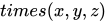
記述的複雑性理論では、要素に全順序が存在し、要素間の等価性をチェックできると仮定することがよくあります。これにより、要素を数値として考えることができます。要素x が数値nを表すのは、次の条件を満たす場合に限ります。要素yとこれによって、原始述語「ビット」も得られる。xの二進展開のk番目のビットのみが 1 である場合に真となります。(加算と乗算を次のような三項関係に置き換えることができます。は、以下の場合に限り真である。そしては、以下の場合に限り真である。)
後継関係と基本的な算術述語を持つ順序構造に限定すると、以下の特徴が得られます。
In circuit complexity, first-order logic with arbitrary predicates can be shown to be equal to AC0, the first class in the AC hierarchy. Indeed, there is a natural translation from FO's symbols to nodes of circuits, with being and of size n. First-order logic in a signature with arithmetical predicates characterises the restriction of the AC0 family of circuits to those constructible in alternating logarithmic time.[2] First-order logic in a signature with only the order relation corresponds to the set of star-free languages.[9][10]
First-order logic gains substantially in expressive power when it is augmented with an operator that computes the transitive closure of a binary relation. The resulting transitive closure logic is known to characterise non-deterministic logarithmic space (NL) on ordered structures. This was used by Immerman to show that NL is closed under complement (i. e. that NL = co-NL).[11]
When restricting the transitive closure operator to deterministic transitive closure, the resulting logic exactly characterises logarithmic space on ordered structures.
On structures that have a successor function, NL can also be characterised by second-order Krom formulae.
SO-Krom is the set of Boolean queries definable with second-order formulae in conjunctive normal form such that the first-order quantifiers are universal and the quantifier-free part of the formula is in Krom form, which means that the first-order formula is a conjunction of disjunctions, and in each "disjunction" there are at most two variables. Every second-order Krom formula is equivalent to an existential second-order Krom formula.
SO-Krom characterises NL on structures with a successor function.[12]
On ordered structures, first-order least fixed-point logic captures PTIME:
FO[LFP]は、単調式の不動点を表す最小不動点演算子による一階述語論理の拡張です。これにより、一階述語論理は再帰を表現する能力を獲得します。ImmermanとVardiによって独立に示されたImmerman –Vardiの定理は、FO[LFP]が順序構造上のPTIMEを特徴づけることを示しています。[ 13 ] [ 14 ]
2025年現在しかし、順序付けされていない構造における PTIME を特徴付ける自然な論理が存在するかどうかは、まだ未解決である。
アビテブール・ヴィアヌの定理によれば、FO[LFP]=FO[PFP]となるのは、FO[LFP]=FO[PFP]となる場合のみであり、したがってP=PSPACEとなる場合のみである。この結果は他の固定点にも拡張されている。[ 7 ]
後継関数が存在する場合、PTIMEは2次ホーン式によって特徴付けられることもあります。
SO-Hornは、SO式を選言標準形で定義できるブールクエリの集合であり、一階述語論理の量化子はすべて全称であり、量化子を含まない部分はHorn形式である。つまり、それはORの大きなANDであり、各「OR」では、おそらく1つを除くすべての変数が否定される。
このクラスは、後継関数を持つ構造ではPと等しい。 [ 15 ]
これらの式は、存在二階ホーン論理のプレネックス式に変換することができる。[ 12 ]
ロナルド・フェイギンが1974年に、複雑性クラスNPが、存在二階述語論理で公理化可能な構造のクラスによって正確に特徴付けられることを証明したことが、記述的複雑性理論の出発点となった。[ 5 ] [ 16 ]
存在式の補集合は普遍式であるため、co-NPは普遍的な二階述語論理によって特徴づけられることが直ちに導かれる。[ 5 ]
したがって、無制限の2階論理は、多項式階層PHに等しい。より正確には、ファギンの定理の次の一般化が得られる。2階の存在量化子と全称量化子がk回交互に多項式階層のk番目のレベルを特徴付ける、前置正規形の式の集合。[ 17 ]
他のほとんどの複雑性クラスの特徴付けとは異なり、フェイギンの定理とその一般化は、構造上の全順序を前提としていません。これは、存在二階論理自体が、二階変数を使用して構造上の可能な全順序を参照するのに十分な表現力を持っているためです。[ 18 ]
The class of all problems computable in polynomial space, PSPACE, can be characterised by augmenting first-order logic with a more expressive partial fixed-point operator.
Partial fixed-point logic, FO[PFP], is the extension of first-order logic with a partial fixed-point operator, which expresses the fixed-point of a formula if there is one and returns 'false' otherwise.
Partial fixed-point logic characterises PSPACE on ordered structures.[19]
Second-order logic can be extended by a transitive closure operator in the same way as first-order logic, resulting in SO[TC]. The TC operator can now also take second-order variables as argument. SO[TC] characterises PSPACE. Since ordering can be referenced in second-order logic, this characterisation does not presuppose ordered structures.[20]
The time complexity class ELEMENTARY of elementary functions can be characterised by HO, the complexity class of structures that can be recognized by formulas of higher-order logic. Higher-order logic is an extension of first-order logic and second-order logic with higher-order quantifiers. There is a relation between the th order and non-deterministic algorithms the time of which is bounded by levels of exponentials.[8]
We define higher-order variables. A variable of order has an arity and represents any set of -tuples of elements of order . They are usually written in upper-case and with a natural number as exponent to indicate the order. Higher-order logic is the set of first-order formulae where we add quantification over higher-order variables; hence we will use the terms defined in the FO article without defining them again.
HO is the set of formulae with variables of order at most . HO is the subset of formulae of the form , where is a quantifier and means that is a tuple of variable of order with the same quantification. So HO is the set of formulae with alternations of quantifiers of order , beginning with , followed by a formula of order .
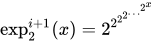
Using the standard notation of the tetration, and . with times
Every formula of order th is equivalent to a formula in prenex normal form, where we first write quantification over variable of th order and then a formula of order in normal form.
HO is equal to the class ELEMENTARY of elementary functions. To be more precise, , meaning a tower of 2s, ending with , where is a constant. A special case of this is that , which is exactly Fagin's theorem. Using oracle machines in the polynomial hierarchy,