Loading article…
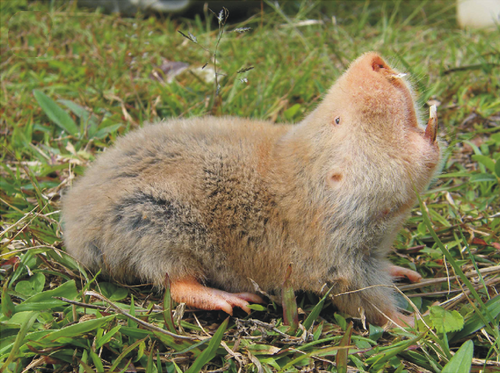
The blesmols, also known as mole-rats or African mole-rats, are burrowing rodents of the family Bathyergidae. They represent a distinct evolution of a subterranean life among rodents much like the pocket gophers of North America, the tuco-tucos in South America, and the Spalacidae from Eurasia.
Modern blesmols are found strictly in sub-Saharan Africa. Fossil forms are also restricted almost exclusively to Africa, although a few specimens of the Pleistocene species Cryptomys asiaticus have been found in Israel.[1] Nowak (1999) also reports that †Gypsorhychus has been found in fossil deposits of Mongolia.
Blesmols are somewhat mole-like animals with cylindrical bodies and short limbs. They range from 9 to 30 cm (3.5 to 11.8 in) in length, and from 30 to 1,800 g (1.1 to 63.5 oz) in weight, depending on the species. Blesmols, like many other fossorial mammals, have greatly reduced eyes and ear pinnae, a relatively short tail, loose skin, and (aside from the hairless naked mole rat) velvety fur. Blesmols have very poor vision, although they may use the surfaces of their eyes for sensing air currents. Despite their small or absent pinnae, they have a good sense of hearing, although their most important sense appears to be that of touch. Like other rodents, they have an excellent sense of smell, and they are also able to close their nostrils during digging to prevent them from clogging with dirt.[2]
The eyes of blesmols are structurally normal, despite their relatively small size, and include normal light-sensitive cells. However, the visual centres of their brains are reduced in certain respects, especially in those centres concerned with localising objects in the visual field. Research has shown that at least two species of blesmol (Fukomys mechowii and Heliophobius argenteocinereus) are not blind, as commonly believed, and will actively avoid blue or green-yellow light. They do not appear able to detect the presence of red light, and can probably not distinguish between different colours. The ability to sense the presence of light is probably useful in allowing them to detect breaches in their tunnel systems and repair them promptly.[3]
ほとんどのブレスモル種は強力な切歯と、程度は低いものの前爪を使って穴を掘りますが、砂丘ブレスモルは主に足で掘るため、柔らかい砂質の土壌に限られます。[ 2 ]砂丘ブレスモルを除いて、一部の種はコンクリートの囲いの壁に1インチ(2.5cm)ほど巣穴を伸ばすことができると報告されています。彼らの独特な頭蓋骨の形状は、口の前部を強く噛む役割を担う側方咬筋に純粋な力を伝えることに関係しています。ブレスモルの切歯は前方に突き出ており、口を閉じても口から出ています。この状態により、動物は口の中に土が入ることなく歯で穴を掘ることができます。頬歯の数は種によって大きく異なり、これは齧歯類では珍しい特徴であるため、この科の歯式は次のようになります。
ブレスモル類の頭蓋骨形態は、他の齧歯類とは一線を画している。亜目に属する他の齧歯類と同様に、ブレスモル類の顎はヤマアラシ型であるが、近縁種とは異なり、眼窩下孔が著しく縮小している。内側咬筋は眼窩下孔をわずかにしか通過しないため、多くの専門家はブレスモル類を前口蓋型とみなしている。したがって、ブレスモル類は唯一の前口蓋型ヤマアラシ類である。
ブレスモルは複雑な巣穴システムに生息し、種によって社会性の程度は異なります。ほとんどの種は単独生活ですが、ダマラランドブレスモル(Fukomys damarensis )は、ハダカデバネズミと並んで、真社会性を持つ哺乳類2種のうちの1種です。これらの種は、コロニー内に繁殖能力のあるオスとメスがそれぞれ 1匹ずつ存在し、残りの個体は不妊であるという特徴があります。
これらの動物は、砂質の緩い土壌を好み、乾燥した生息地と関連付けられることが多い。めったに地上に出てこず、一生を地下で過ごす。ブレスモルは草食性で、主に根、塊茎、球根を食べる。巣穴から出ることなく、小さな植物を根ごと地下に引きずり込むことができ、通常では食べられない葉、茎、その他の植物の部分を食べることができる。ブレスモルは餌を求めて穴を掘り、トンネルの大部分はこうした採餌用の巣穴で構成され、その周囲に少数の貯蔵場所、巣、排泄室がある。[ 2 ]
ほとんどの種は年に1回か2回しか繁殖しないが、中には一年中繁殖する種もいる。一般的に、一度に2~5匹の子を産む。これはおそらく、生息環境が十分に安全であるため、他の多くの齧歯類のように急速に個体数を維持する必要がないためだろう。しかし、ハダカデバネズミのように平均12匹、時にはそれ以上の子を産む種もいる。[ 2 ]

バティエルギ科は単系統群であり、すべての分類群は単一の共通祖先に遡る。[ 4 ]多少の議論はあるものの、ブレスモルの最も近縁な現生種は、スリオノミ科(サトウキビネズミ)とペトロムリ科(イワダヌキネズミ)に属する他のアフリカヤマアラシ類であると思われる。これら3つの現生科と化石種を合わせて、フィオモルファ下目を構成する。[ 5 ]


現在、5属21種のブレスモルが認められているが、[ 6 ] [ 7 ] [ 8 ]この数は増加する可能性が高い。ポケットゴファー、トゥコトゥコ、盲目モグラネズミなどの他の穴居性齧歯類と同様に、ブレスモルは急速に種分化しているようだ。地理的に容易に隔離され、さまざまな染色体形態と遺伝的に異なる亜種が生じる。いくつかの研究では、 Bathyergus属が最も基底的な系統を表していると示唆されている。多くの研究者はハダカデバネズミ、Heterocephalusがその位置を占めていると仮定していたが、[ 6 ] [ 7 ] [ 9 ]最近の調査では、この属は別の科であるHeterocephalidaeに分類されている。[ 10 ] [ 11 ] [ 12 ]