
Loading article…
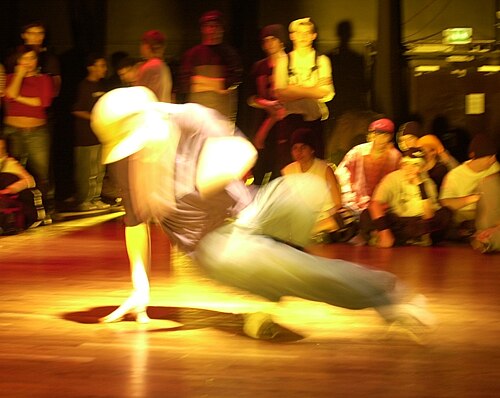
The 6-step is the basic sequence of breakdancing footwork.[1] The dancer uses their arms to support their body above the floor while moving their legs in a circle.
The 6-step is foundational to b-boying not only because it is the first footwork sequence breakers often learn, but also because it remains the move around which many sets are structured. Many break moves can begin from the 6-step. The move sets up the direction of rotation and builds momentum while imparting body control. The breaker stays low and in contact with the ground, which places him in perfect position for performing other moves. Each of the six distinct steps puts the body in a different position which can be used as starting points for other moves. Steps 1/2 and 3/4 (described below) are most often used for launching other moves. Conversely, any move which ends on the ground can be transitioned smoothly back into the 6-step.
The body position after step (2) and step (4) are mirror images of each other. Six step often involves looking straight ahead constantly and placing the feet in the same place for each rotation, but can be done with your body facing a different direction for each rotation.
While the basic 6-step resembles walking in a circle on the ground, there are many variations of footwork or "techs" that can reverse the direction of rotation, interlock limbs, incorporate minor flares, twists, powermoves, freezes, tweaks, and much more.
数多くの6ステップのバリエーションの中で、6ステップ自体と同様に明確な反復パターンを持つものはごくわずかであり、そのため、それらは独立したフットワークシーケンスとして認識されています。最も広く知られているものを以下に示します。実験的なブレイクダンサーは、独自のフットワークシーケンスを考案し、それを「9ステップ」などと呼んでいますが、これらのシーケンスは広く認知されていません。さらに、2ステップのような動きは、名称が似ていても、6ステップとはあまり関係がありません。
6ステップの簡略版。唯一の違いは、最初の2つのステップが1つに統合されている点です。ダンサーは前足を少し伸ばした状態で2番目のステップにジャンプします。
6ステップの簡単なバリエーションです。最初のステップは同じですが、2番目のステップで左足を右足の上に重ねます。ここから右足を前に蹴り出し、6ステップの3番目のステップの途中の位置まで移動します。右足を元の位置に戻して、5番目のステップを続けます。
ブレイクダンサーが手の代わりに頭を台として使う、6段階のバリエーション。