
Loading article…
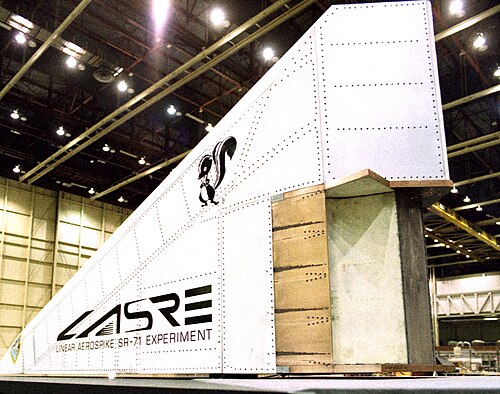
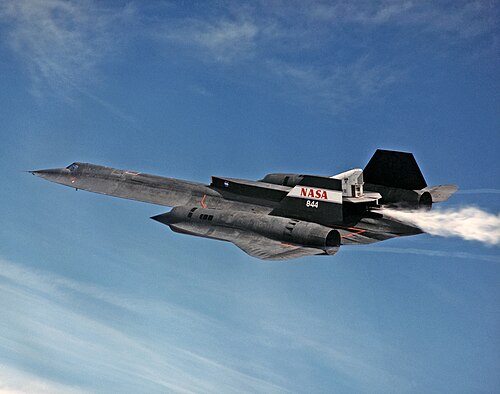

LASRE was NASA's Linear Aerospike SR-71 Experiment which took place at the Dryden Flight Research Center at Edwards Air Force Base, California, until November 1998. The experiment sought to provide flight data to help Lockheed Martin validate and tune the computational predictive tools used to determine the aerodynamic performance of the Lockheed Martin X-33lifting body and linear aerospike engine combination and to lay groundwork for a future reusable launch vehicle.[1]
LASRE was a small, half-span model of the X-33's lifting body with eight thrust cells of an aerospike engine, rotated 90 degrees and mounted on the back of a Lockheed SR-71 Blackbird aircraft, to operate like a kind of "flying wind tunnel." The experiment focused on determining how a reusable launch vehicle's engine plume would affect the aerodynamics of its lifting body shape at specific altitudes and speeds reaching about 750 miles/hour (335 meter/second or 1207 km/h). Design refinements looked to minimize the interaction of the aerodynamic flow with the engine plume, which could create drag.[2]
The aircraft completed seven research flights. Two initial flights were used to determine the aerodynamic characteristics of the LASRE apparatus on the back of the aircraft. The first of those occurred 31 October 1997. The SR-71 took off at 8:31 a.m. (Pacific Standard Time-PST).[2] The aircraft flew for 1:50 hour, reaching Mach 1.2 and an altitude of 33,000 feet (10,000 m), landing at Edwards AFB. The result validated the SR-71/pod configuration.[3]
Five later flights focused on the experiment; two were used to cycle gaseous helium and liquid nitrogen through the experiment to check its plumbing system for leaks and to check engine operation characteristics. The first of these flights occurred 4 March 1998. The SR-71 took off at 10:16 a.m. PST. The aircraft flew for 1:57 hour, reaching Mach 1.58 before landing at Edwards AFB.[2]
1998年の春と夏に行われたさらに3回の飛行では、液体酸素がエンジンに循環された。加えて、地上で2回のエンジンの高温燃焼試験が行われた。試験装置からの液体酸素の漏れのため、研究者らは高温燃焼飛行試験を行わないことを決定した。地上での燃焼試験と空中での極低温ガス流量試験により、飛行中のエアロスパイクエンジンの燃焼による高温ガスの影響を予測するのに十分な情報が得られた。[ 4 ]
実験自体は、揚力体形状の小型の半分の翼幅の模型でした。模型にはエアロスパイクエンジンの8つの推力セルが含まれており、「カヌー」と呼ばれるハウジングに取り付けられていました。このハウジングには、水素ガス、ヘリウム、および計測機器が収められていました。[ 2 ]
モデル、エンジン、カヌーを合わせて「ポッド」と呼ばれた。ポッド全体の長さは41フィート、重量は14,300 ポンドだった。実験用ポッドはNASAのSR-71に搭載された。[ 2 ]
ロッキード・マーティンは、LASREとX-33先進技術実証機から得た情報を利用して、将来の再利用可能な打ち上げロケットを開発する可能性がある。NASAとロッキード・マーティンは、協力協定を通じてX-33プログラムでパートナーだった。[ 2 ]
X-33計画の目標、そしてNASA航空宇宙技術局の主要目標は、宇宙へのアクセスコストを大幅に削減し、新たな宇宙サービスやその他の活動の創出と提供を促進して、米国の経済競争力を向上させることであった。この計画は、国家宇宙輸送政策を実施したものであり、国家宇宙打ち上げ産業の継続的な商業化に貢献するために、新たな打ち上げ技術と概念の開発を加速させることを目的としている。[ 2 ]
X-33と小型のX-34技術試験機はどちらも、アラバマ州ハンツビルにあるNASAマーシャル宇宙飛行センターの宇宙輸送プログラムオフィスの管轄下にあった。空中発射型の翼付きX-34は、宇宙へのアクセスコストを劇的に削減するために設計された次世代再利用型打ち上げロケットに適用可能な技術を実証することも目的としていた。[ 2 ]
 この記事には、パブリックドメインにあるこの情報源からのテキストが含まれています。