
Loading article…
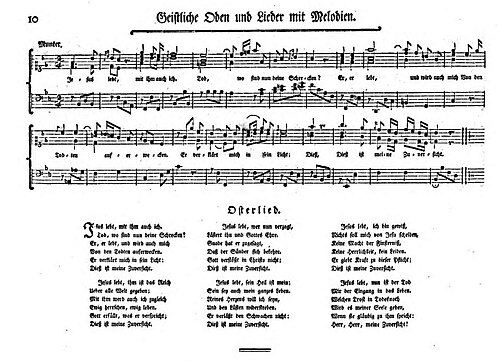
Geistliche Oden und Lieder ("Sacred Odes and Songs", H. 686, Wq 194), also known as Gellert Oden ("Gellert Odes"), is a collection of songs by Carl Philipp Emanuel Bach with texts by Christian Fürchtegott Gellert. Originally published in 1758, Bach's work enjoyed continuous popularity for several decades and influenced numerous composers, most importantly Ludwig van Beethoven, who composed his own settings of six of Gellert's poems.
One of the best known German poets of his time, Christian Fürchtegott Gellert was a professor of philosophy at Leipzig University. In 1757, at age 42, he published Geistliche Oden und Lieder, a collection of sacred poetry that enjoyed considerable success. Gellert himself suggested that the poems could be sung to traditional chorale melodies, and although the poetry employs a vast number of forms and techniques, provisions were made by Gellert to make musical settings possible.[1]
According to the foreword to the first edition of Geistliche Oden und Lieder, written by Bach himself, the composer was so impressed with the poetry that it suggested to him a novel kind of song setting; he proceeded to create settings for all 54 of Gellert's poems – however, in Bach's collection the order of poems is completely different from Gellert's volume.[2] The volume was published by George Ludewig Winter in 1758; Bach's foreword is dated February 1, 1758. Both Gellert's poetry and Bach's setting of it enjoyed considerable popularity: several more collections of settings of Gellert's poems appeared, including some by distinguished composers such as the famous music theorist Friedrich Wilhelm Marpurg, and Johann Friedrich Doles, a pupil of Johann Sebastian Bach). In the 19th century, Beethoven published six settings of Gellert's poems as Gellert Lieder., Op. 48 (1802), influenced both by the poet and by Bach's settings of his poetry.
バッハの生前、『ゲッレールト・オーデン』は5回再版され、最後の版は1784年に出版された。[ 3 ]バッハの作曲は、54篇の詩すべてを網羅した唯一の完全なものであった。このコレクションの成功は、バッハにさらに多くの宗教歌曲を作曲する意欲を与えた。これには、 『詩篇と旋律』 (1774年、H. 733、Wq 196)と題された42篇の詩篇集、および1780年から81年にかけて2巻の『宗教歌と旋律』(H. 749、752、Wq 197、198)として出版された60篇の宗教歌が含まれる。
ゲレールトの詩はそれぞれ複数のスタンザから成り、スタンザの構造は詩全体を通して一定である。そのため、バッハの楽曲は1つのスタンザに音楽を与え、詩のスタンザの数だけ繰り返し、即興演奏を行うことができる。後の歌曲集とは異なり、楽譜は3段ではなく2段で書かれている。伴奏のスタイルはバロック時代の通奏低音の慣習に由来しており、バッハ自身も序文で、演奏技術の未熟な通奏低音奏者が音楽を台無しにしないように、旋律に和音を加えたと述べている。とはいえ、各パートは十分にシンプルで装飾が少ないため、演奏者による装飾や即興演奏を自由に行うことができる。