
Loading article…
An effusive eruption is a type of volcanic eruption in which lava steadily flows out of a volcano onto the ground.

There are two major groupings of eruptions: effusive and explosive.[1] Effusive eruption differs from explosive eruption, wherein magma is violently fragmented and rapidly expelled from a volcano. Effusive eruptions are most common in basaltic magmas, but they also occur in intermediate and felsic magmas. These eruptions form lava flows and lava domes, each of which vary in shape, length, and width.[2] Deep in the crust, gasses are dissolved into the magma because of high pressures, but upon ascent and eruption, pressure drops rapidly, and these gasses begin to exsolve out of the melt. A volcanic eruption is effusive when the erupting magma is volatile poor (water, carbon dioxide, sulfur dioxide, hydrogen chloride, and hydrogen fluoride), which suppresses fragmentation, creating an oozing magma which spills out of the volcanic vent and out into the surrounding area.[1] The shape of effusive lava flows is governed by the type of lava (i.e. composition), rate and duration of eruption, and topography of the surrounding landscape.[3]
For an effusive eruption to occur, magma must be permeable enough to allow the expulsion of gas bubbles contained within it. If the magma is not above a certain permeability threshold, it cannot degas and will erupt explosively. Additionally, at a certain threshold, fragmentation within the magma can cause an explosive eruption. This threshold is governed by the Reynolds number, a dimensionless number in fluid dynamics that is directly proportional to fluid velocity. Eruptions will be effusive if the magma has a low ascent velocity. At higher magma ascent rates, the fragmentation within the magma passes a threshold and results in explosive eruptions.[4]Silicic magma also exhibits this transition between effusive and explosive eruptions,[5] but the fragmentation mechanism differs.[4] The 1912 Novarupta eruption and the 2003 Stromboli eruption both exhibited a transition between explosive and effusive eruption patterns.[5][6]
Basaltic composition magmas are the most common effusive eruptions because they are not water saturated and have low viscosity. Most people know them from the classic pictures of rivers of lava in Hawaii. Eruptions of basaltic magma often transition between effusive and explosive eruption patterns. The behavior of these eruptions is largely dependent on the permeability of the magma and the magma ascent rate. During eruption, dissolved gasses exsolve and begin to rise out of the magma as gas bubbles.[7] If the magma is rising slowly enough, these bubbles will have time to rise and escape, leaving a less buoyant magma behind that fluidly flows out. Effusive basalt lava flows cool to either of two forms, ʻaʻā or pāhoehoe.[8] This type of lava flow builds shield volcanoes, which are, for example, numerous in Hawaii,[9] and is how the island was and currently is being formed.
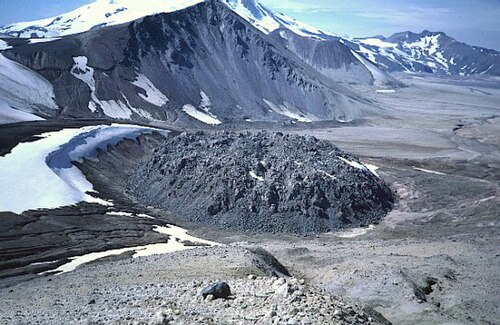
珪長質マグマは最も一般的には爆発的に噴火するが、噴出することもある。[ 10 ]これらのマグマは水で飽和しており、[ 11 ]玄武岩質マグマよりも何桁も粘性が高いため、脱ガスと噴出がより複雑になる。マグマ溜まりを取り囲む母岩の亀裂を通して噴火前に脱ガスすること、 [ 12 ]が重要な役割を果たす。ガス泡が小さな隙間から逃げ出し、圧力を解放し、地表では高密度のガスの噴出孔として見える。[ 13 ]マグマの上昇速度は、どのタイプの噴火になるかを制御する最も重要な要素である。珪長質マグマが噴出するには、ガスが周囲の岩石に溶脱して拡散する時間を確保するために、上昇速度が 10 −5~ 10 −2 m/s で、透過性のある導管壁が必要であり、[ 4 ]流速が速すぎると、導管が透過性であっても、不透過性であるかのように作用し[ 4 ]、爆発的噴火を引き起こします。珪長質マグマは、その高い粘性[ 15 ]により玄武岩質マグマのように流動しないため、通常はブロック状の溶岩流[ 14 ]または溶岩ドームと呼ばれる急斜面の丘を形成します。珪長質ドームが形成されるときは、導管の内部および上部に配置されます。 [ 16 ]噴火の初期にドームが形成されて十分に結晶化すると、それはシステムのプラグとして作用し[ 16 ]、主な脱ガス機構を阻害します。このようなことが起こると、溶岩ドームの下で圧力が蓄積されるため、噴火が流出型から爆発型に変化することが一般的です。[ 10 ]