
Loading article…
The Charles Pinckney National Historic Site is a unit of the United States National Park Service, preserving a portion of Charles Pinckney'sSnee Farmplantation and country retreat.[4][5][6][7] The site is located at 1254 Long Point Road, Mount Pleasant, South Carolina. Pinckney (1757–1824) was a member of a prominent political family in South Carolina. He fought in the American Revolutionary War, was held for a period as prisoner in the North, and returned to the state in 1783. Pinckney, a Founding Father of the United States, served as a delegate to the constitutional convention where he contributed to drafting the United States Constitution.
This Snee Farm site was designated as a National Historic Landmark in 1973, and was designated a National Historic Site in 1988.
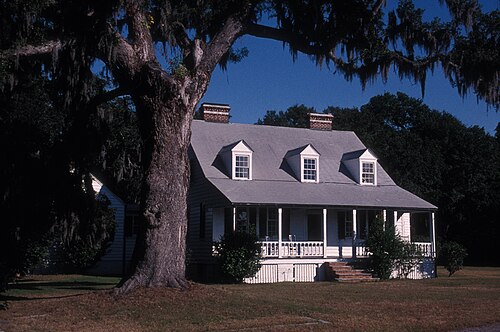
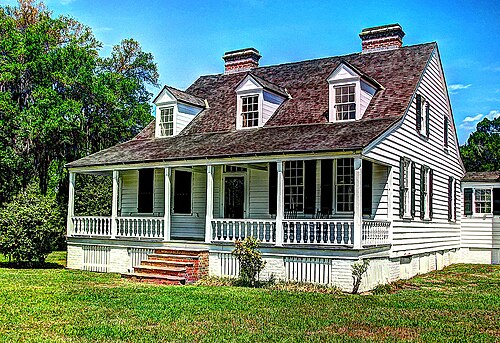
The Charles Pinckney National Historic Site is located about 10 miles (16 km) northeast of Charleston, South Carolina, on 25 acres (10 ha) of Wando Neck, a peninsula formed at the confluence of the Wando and Cooper rivers. The site has wooded and swampy areas on the eastern and western parts of the property, and a manicured grassy area with ornamental plantings around the main house. The property includes, in addition to the main house, a barn, corncrib, and caretaker's residence. A stone cenotaph was erected in the late 20th century to commemorate Colonel Charles Pinckney, the father of governor Pinckney, who had acquired and developed Snee Farm as a rice and indigo plantation. It may have replaced an historic one installed by the younger Pinckney about 1785.[4]
スニー農場は、1754 年にチャールズ・ピンクニー大佐が未亡人アン(スコット)アレンと彼女の二番目の夫でチャールストンの商人であったジョン・サベージから取得したものであり、 [ 8 ]彼はその 715 エーカーを米と藍の商品作物のために開発しました。彼はそれを息子のチャールズに遺贈し、チャールズは 1782 年にそれを相続しました。若いピンクニーは、1816 年頃までスニー農場を農園および田舎の邸宅として使用し(船でチャールストンに簡単にアクセスできました)、その頃に負債を返済するためにその土地を信託財産としました。
この土地は1817年にフランシス・G・デリエセリンによって取得され、測量された。ローカントリーの別の農園主であるウィリアム・マシューズは1828年にこの土地を購入した。彼は既存の建物を解体し、その年に新しい本館を建てたが、それは最初の基礎があった元の場所であったようだ。マシューズは他にも農園を所有しており、合計352人の奴隷を所有していたことから[ 9 ]、数千エーカーの土地を所有していたことがわかる。彼は1848年までスニー農場を所有していた。
スニー農場の沿岸コテージは当時の典型的なもので、田舎暮らしの土着様式を代表するものですが、もてなしのための洗練された空間も備えています。平面は長方形で、切妻屋根、正面には幅いっぱいのポーチ、レンガ造りの柱基礎があります。内部には精巧なモールディング、羽目板、その他の装飾が施されています。奴隷小屋の列は、主要道路に垂直に建てられました。[ 9 ]
715エーカーの敷地とその付属建物は、1970年代に所有者がチャールストン近郊の開発で利益を得るために分割するまで、ほぼそのままの状態で残っていた。歴史的な敷地の中央部分、つまり家屋と28エーカーが現在の敷地を構成しており、1988年に保存活動家によって購入された。米国議会による関連法案の可決後、国立公園局が現在の敷地を購入した。敷地内にはピンクニー家に関連する建造物がもはや存在しないため、彼らがこの土地に住んでいた時代の詳細は考古学的調査と文書調査に限られている。[ 4 ]歴史的な敷地内にある現代の博物館には、ピンクニー家とその後のスニー農場の所有者による約200年にわたる遺物が収蔵されている。そこに保管されている173,000点を超える品々には、奴隷が作った陶器や18世紀と19世紀の食器など、プランテーション生活の遺物が含まれている。 [ 10 ]
 ウィキメディア・コモンズにあるチャールズ・ピンクニー国立史跡関連のメディア