Tin(IV) sulfide is a compound with the formulaSnS2. A brown, water-insoluble solid, it is a semiconductor with band gap 2.2eV.[5] It occurs naturally as the rare mineralberndtite.[6]
Synthesis and structure
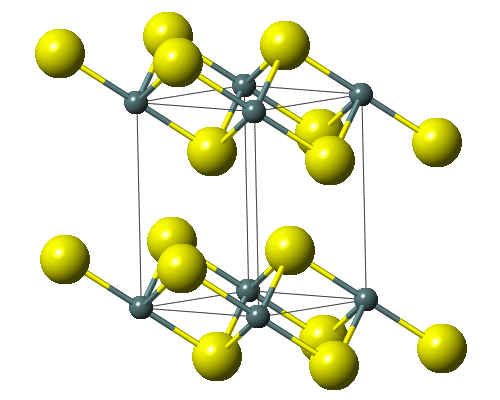
Fragment of the SnS2 lattice. Color code: yellow = S, gray = Sn.
The compound precipitates as a brown solid upon the addition of H2S to solutions containing tin(IV) species. This reaction is reversed at low pH. It can also be prepared by heating finely ground Sn with excess sulfur.[7]
The compound crystallizes in the cadmium iodide motif, with the Sn(IV) situated in "octahedral holes' defined by six sulfide centers.[8]
The material reacts with sulfide salts to give a series of thiostannates with the formula [SnS2]m[S]2n−n.[9] A simplified equation for this depolymerization reaction is:
SnS2 + S2− →1/x[SnS32−]x
Potential uses
Crystalline SnS2 has a bronze color and is used in decorative coating[10] where it is known as mosaic gold.
↑Comey, Arthur Messinger; Hahn, Dorothy A. (February 1921). A Dictionary of Chemical Solubilities: Inorganic (2nded.). New York: The MacMillan Company. p.1080.
1 2 3 4 5 Voort, GF Vander 編 (2004). "結晶構造*". Metallography and Microstructures . Vol. 9. pp. 29–43 . doi : 10.31399/asm.hb.v09.a0003722 . ISBN978-1-62708-177-1。
↑ Burton, Lee A.; Whittles, Thomas J.; Hesp, David; Linhart, Wojciech M.; Skelton, Jonathan M.; Hou, Bo; Webster, Richard F.; O'Dowd, Graeme; Reece, Christian; Cherns, David; Fermin, David J.; Veal, Tim D.; Dhanak, Vin R.; Walsh, Aron (2016). "単結晶 SnS 2の電子特性と光学特性: 地球上に豊富に存在する二硫化物光触媒". Journal of Materials Chemistry A . 4 (4): 1312– 1318. doi : 10.1039/C5TA08214E . hdl : 1983/fb4a478e-aa5e-4f09-abe3-dce1343f709d .