
Loading article…
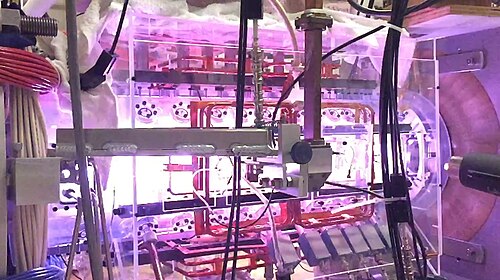
プリンストン磁場反転構成(PFRC )は、プリンストンプラズマ物理研究所(PPPL)で行われている、核融合発電炉の構成を評価するための実験プログラムである、プラズマ物理学の一連の実験です。この実験では、奇パリティ回転磁場によって形成される、長パルス、無衝突、 [ 1 ]低sパラメータ[ 2 ]の磁場反転構成(FRC)のダイナミクスを調べます。[ 3 ] [ 4 ] FRCは、ギリシャのエンジニア、ニコラス・C・クリストフィロスがアストロン核融合炉のために開発したE層というオリジナルのアイデアの進化形です。[ 5 ] PFRCプログラムは、このような構成が全体的に安定しており、古典的な磁気拡散に匹敵する輸送レベルを持つという物理的予測を実験的に検証することを目的としています。[ 2 ]また、この技術を宇宙船推進のための直接核融合駆動コンセプトに適用することも目的としています。 [ 6 ]
PFRCは当初、米国エネルギー省の資金援助を受けて設立された。運用開始当初は、トランスレーション・コンフィンメント・サステイニング実験(TCS)やプレーリービュー・ロタマク(PVロタマク)といったRMF-FRCと同時期に運用されていた。
PPPLでは、PFRC-1実験が2008年から2011年まで実施された。[ 7 ] PFRC-2は2023年現在も実施中である。PFRC-3が次に予定されている。PFRC-4は2020年代後半に予定されている。[ 7 ]
2023年現在核融合は達成されなかった。
PFRC-1およびPFRC-2実験では、電子を100 eVを超えるエネルギーまで加熱し、プラズマの持続時間を300 msまで延長しました。これは、予測される傾斜不安定性の成長時間の10 4倍以上です。[ 8 ]

The electric current that forms the field-reversed configuration (FRC) in the PFRC is driven by a rotating magnetic field (RMF). This method has been well-studied and produced favorable results in the Rotamak series of experiments.[9] However, rotating magnetic fields as applied in these and other experiments (so-called even parity RMFs) induce opening of the magnetic field lines. When a transverse magnetic field is applied to the axisymmetric equilibrium FRC magnetic field, rather than magnetic field lines closing on themselves and forming a closed region, they spiral around in the azimuthal direction and ultimately cross the separatrix surface which contains the closed FRC region.[3]
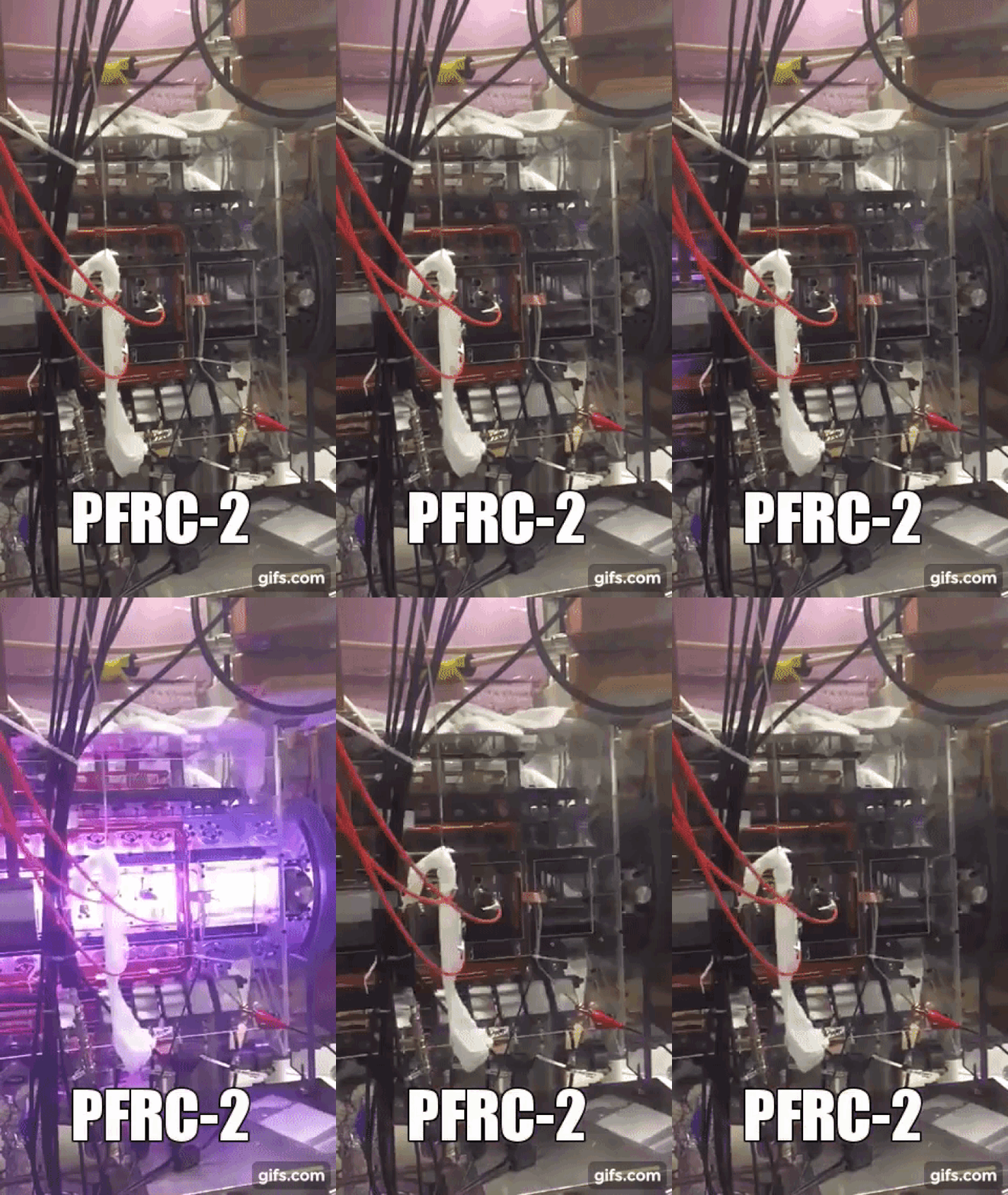
The PFRC uses RMF antennae that produce a magnetic field which flips direction about a symmetry plane oriented with its normal along the axis, half-way along the length of the axis of the machine. This configuration is called an odd parity rotating magnetic field (RMFo). Such magnetic fields, when added in small magnitude to axisymmetric equilibrium magnetic fields, do not cause opening of the magnetic field lines and overall topology is preserved.[3] The critical threshold magnitude of 'odd parity' rotating magnetic field which opens up the axisymmetric equilibrium magnetic field lines and fundamentally changes field topology is rather high.[10] Thus, the RMF is not expected to contribute to transport of particles and energy out of the core of the PFRC.
In an FRC, the name s-parameter is given to the ratio of the distance between the magnetic null and the separatrix, and the thermal ion Larmor radius. That is how many ion orbits can fit between the core of the FRC and where it meets the bulk plasma.[2] A high-s FRC would have very small ion gyroradii compared to the size of the machine. Thus, at high s-parameter, the model of magnetohydrodynamics (MHD) applies.[11] MHD predicts that the FRC is unstable to the "n=1 tilt mode," in which the reversed field tilts 180 degrees to align with the applied magnetic field, destroying the FRC.
低s FRCは傾斜モードに対して安定であると予測される。[ 11 ] sパラメータが2以下であれば、この効果には十分である。しかし、高温コアと低温バルクの間にはイオン半径が2つしかないため、平均して2つの散乱周期(平均90度の速度変化)だけで、高温の核融合関連イオンをプラズマのコアから取り除くのに十分である。したがって、選択肢は、古典的に閉じ込められているが対流的に閉じ込められていない高sパラメータイオンと、古典的に閉じ込められていないが対流的に閉じ込められている低sパラメータイオンのどちらかである。
PFRC の s パラメータは 1 ~ 2 の間です。[ 2 ]傾斜モードを安定させることは、許容できる衝突の数が少なければ閉じ込めに悪影響を与えるよりも、閉じ込めを助けると予測されています。
プリンストン衛星システムズの科学者たちは、PFRC をベースに、排気が流れて推力を発生させる開口部が片側だけあるDirect Fusion Drive (DFD) と呼ばれる新しい概念に取り組んでいます。 [ 7 ]これは、単一の小型核融合炉から電力と推進力を生成します。最初の概念研究とモデリング (フェーズ I NASA NIAC) は 2017 年に発表され、[ 12 ]冥王星周回機と着陸機の推進システムに電力を供給するために提案されました。[ 12 ] [ 13 ]低温プラズマの流れに推進剤を加えると、磁気ノズルを通して流したときに可変推力が発生します。モデリングによると、DFD は生成される核融合電力1メガワットあたり5ニュートンの推力を生成する可能性があります。 [ 14 ]核融合エネルギーの約35%が推力に、30%が電力に、25%が熱として失われ、10%が高周波(RF)加熱のために再循環される。[ 12 ]このコンセプトは、設計と遮蔽をさらに進めるためにフェーズIIに割り当てられた。[ 15 ]