
Loading article…
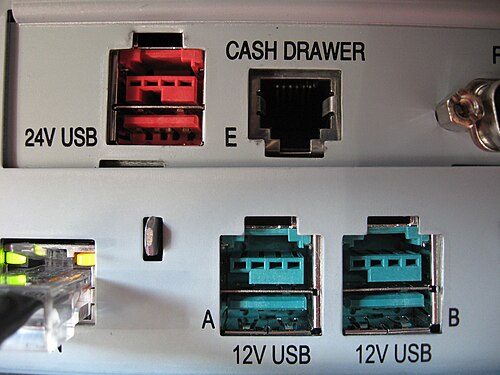
PoweredUSB, also known as Retail USB, USB PlusPower, USB +Power, and USB Power Plus,[1] is an addition to the Universal Serial Bus standard that allows for higher-power devices to obtain power through their USB host instead of requiring an independent power supply or external AC adapter. It is mostly used in point-of-sale equipment, such as receipt printers, touch screens and barcode readers.
PoweredUSB, as a proprietary variant of USB, was developed and proposed by IBM, Berg Electronics (now a subsidiary of Amphenol), NCR Corporation, and Microsoft between 1998 and 1999, with the last revision (0.8g) issued in 2004. The specification is not endorsed by the USB Implementers Forum (USB-IF).[2][3] IBM, who owns patents to PoweredUSB,[4][5] charges a licensing fee to manufacturers for its use.[6]
PoweredUSB was licensed by Hewlett-Packard, Toshiba, Epson, Fujitsu, Wincor-Nixdorf, Siemens, among others.[7]
PoweredUSB uses a more complex connector than standard USB, maintaining the standard connector of USB 1.x and USB 2.0 interface for data communications and adding a second connector for power. Physically, it is essentially two connectors stacked such that the bottom connector accepts a standard USB plug and the top connector takes a power plug.
The implementation allows a choice of three different voltages, providing power at 5 V (30 W), 12 V (72 W), 24 V (144 W) as well as a custom voltage. Some implementations provide 19 V or 25 V. The connectors are able to operate at up to 6 A (3 A per pin) peak, but according to the specification, hosts are required to provide a minimum sustainable rms current of 1.5 A at 5 V (7.5 W) or 12 V (18 W), or 2.3 A at 24 V (55.2 W), only.
比較のために、標準的な USB 1.x および 2.0 ホストは 最大 0.5 A (2.5 W) で 5 V を供給します。[ 8 ] USB 3.0 は最大 0.9 A (4.5 W)で5 V を供給します[ 9 ] :セクション 9.2.5.1 電力バジェット一方、 USB バッテリー充電仕様に準拠したホストは最大 1.5 A (7.5 W)を供給できます。
PoweredUSB プラグはそれぞれ 3 つの電圧のうちの 1 つを提供するので、プラグは 3 つのバージョンでキーイングされており、そのバージョンの電圧を必要とするデバイスからの接続のみを受け入れるようになっています。[ 3 ]コネクタは、異なる電圧に応じて色分けされています。5 V の場合はグレー ( Pantone Cool Gray 1C) (場合によっては「自然」または黄色) 、12 V の場合は青緑 (Pantone Teal 3262C) 、24 V/25 V の場合は赤 (Pantone Red 032C) 、19 V の場合は紫です。あるいは、5 V を超える電圧は、コネクタの色を黒にすることで示すことができます。
各種メーカーから入手可能なコネクタは、偶発的な停電のリスクを軽減するために自動ロック機能を備えています。ホットプラグ対応の特別な対策を推奨しますが、必須ではありません。赤色の24ボルトプラグは、ユニットの電源が入っている状態では絶対に抜き差ししないでください。
2012年、USB-IFはUSB 2.0および3.x仕様のオプション部分としてUSB Power Delivery仕様(USB PD)をリリースしました。これはPoweredUSBで扱われている機能と同様の機能を定義していますが、独自のコネクタの使用は不要です。代わりに、USB 2.0および3.0規格で定義されているコネクタが引き続き使用されます。ただし、より高い電流にはPD対応のUSBケーブルが必要です。このUSB仕様に準拠したUSBホストは、USBデバイスから代替電圧(9、15、20V )とより高い電流( 5Vで最大3A (最大消費電力15W )、オプションで12V (60W )または20V (100W )で最大5A )を提供するように要求できます。[ 10 ]