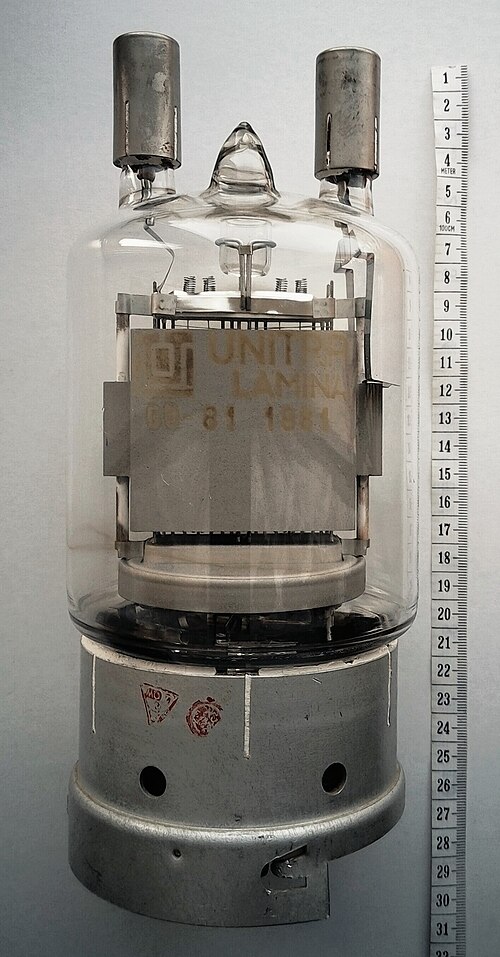
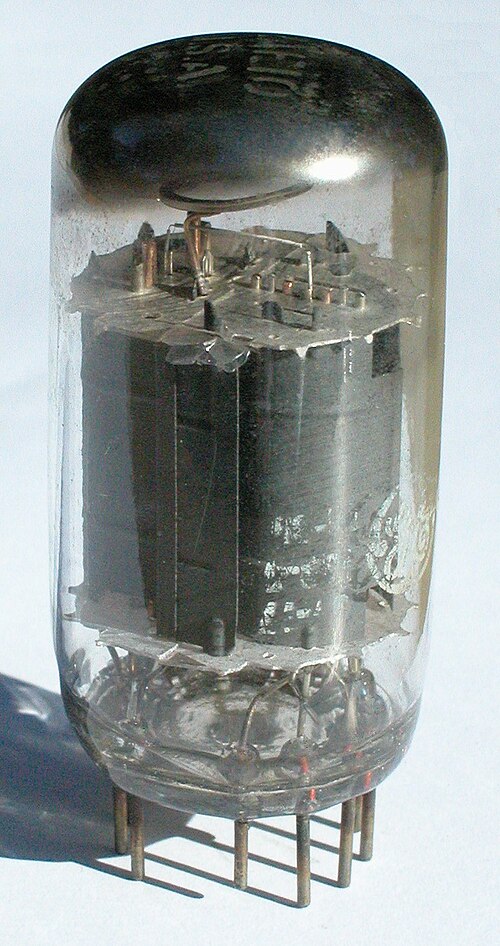
Graphic symbol representing a pentode of the indirectly heated cathode class Electrodes, listed from top to bottom: anode, suppressor grid, screen grid, control grid, cathode
A pentode is an electronic device having five electrodes. The term most commonly applies to a three-grid amplifying vacuum tube or thermionic valve that was invented by Gilles Holst and Bernhard D.H. Tellegen in 1926.[1] The pentode (called a triple-grid amplifier in some literature[2]) was developed from the screen-grid tube or shield-grid tube (a type of tetrode tube) by the addition of a grid between the screen grid and the plate. The screen-grid tube was limited in performance as an amplifier due to secondary emission of electrons from the plate.[3] The additional grid is called the suppressor grid. The suppressor grid is usually operated at or near the potential of the cathode and prevents secondary emission electrons from the plate from reaching the screen grid.[4][5] The addition of the suppressor grid permits much greater output signal amplitude to be obtained from the plate of the pentode in amplifier operation than from the plate of the screen-grid tube at the same plate supply voltage. Pentodes were widely manufactured and used in electronic equipment until the 1960s to 1970s, during which time transistors replaced tubes in new designs. During the first quarter of the 21st century, a few pentode tubes have been in production for high power radio frequency applications, musical instrument amplifiers (especially guitars), home audio and niche markets.
単純な四極管、すなわちスクリーングリッド管は、従来の三極管よりも増幅率が高く、出力も大きく、周波数特性も優れていました。しかし、四極管では、 陰極からの電子が陽極(プレート)に衝突して陽極から叩き出された二次電子(二次放出と呼ばれるプロセス)が、比較的高い電位を持つスクリーングリッドに流れ込むことがあります。陽極から流れ出るこの電子の電流は、正味の陽極電流I aを減少させます。陽極電圧V aが増加すると、陰極からの電子が陽極に衝突するエネルギーが大きくなり、より多くの二次電子が叩き出され、陽極から流れ出る電子の電流が増加します。その結果、四極管では、特性曲線の一部において、陽極電流I aは陽極電圧V aの増加とともに減少することがわかっています。この特性(Δ V a /Δ I a < 0)は負性抵抗と呼ばれます。負性抵抗は四極管を不安定にし、場合によっては出力に寄生振動(ダイナトロン振動と呼ばれる)を引き起こす可能性があります。
↑ソリマー、ラズロ (2012).現代物理エレクトロニクス. Springer Science and Business Media. p. 8. ISBN978-9401165075。
↑ ETC Carney, Allen F. (1998). The Navy Electricity and Electronics Training Series, Module 06: Introduction to Electronic Emission, Tubes, and Power Supplies . Pensacola FL: Naval Education and Training Professional Development and Technology Center. p. 1-47.
↑ウィテカー、ジェリー (2016).パワー真空管ハンドブック、第3版. CRC Press. p. 87. ISBN978-1439850657。
↑ライヒ、ハーバート J. (1941).電子管の原理. ニューヨーク: マグロウヒル. p. 62.