
Loading article…


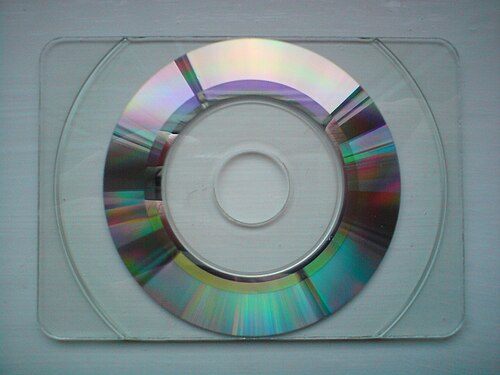
ミニCD、またはポケットCDは、標準的な120mmディスクよりも直径が小さく、記憶容量が3分の1のCDです 。[ 1 ]
さまざまな形式の中には、
1997年、Imaginetのディーン・プロクターは、中央のくぼみがあるクワッドスピードCD-ROMまたはDVDドライブで再生できるフルスクリーンハイファイステレオビデオを収録した名刺サイズの長方形CDを提供していた。さまざまなレーザーカット形状が開発された。[ 2 ]
ミニCDがアメリカで初めて発売されたとき、当初はインチ単位でのサイズにちなんでCD3として販売されていました。より大きなCDはCD5と呼ばれていましたが、どちらのCDの仕様もメートル法単位で定義されていることに変わりはありません。現在では、ミニCDまたは80mm CDとして知られています。
ほとんどのトレイ式CDプレーヤーには、2つの円形のくぼみがあります。1つは通常の120mm CD用のサイズで、もう1つはミニCDを収納するための、より小さく深い円形のくぼみです。ただし、一部のブルーレイプレーヤーは例外です。
スピンドルを備えた機器はミニCDにも対応しており、通常のCDと同様にディスクをスピンドルにセットするだけで使用できます。
縦置き式のトレイローディング方式を採用している機器の中には、例えば旧型の薄型化以前のPlayStation 2本体を縦置きした場合、80mm CDを使用するためにアダプターが必要となるものがあります 。
ほとんどのスロットローディング式CDドライブは一般的に互換性がありません(PlayStation 3、Nintendo Wii、および多くのホンダ車に搭載されているカーCDプレーヤーは例外です)が、80mm の円形ミニCDをはめ込むことで幅を120mm CDの幅に拡張し、多くのスロットローディング式デバイスで使用できるアダプターが市販されています。
1980年代後半から1990年代初頭にかけてのCDプレーヤーのほとんどは、ミニCDの円形の切り欠きに対応しておらず、アダプターを使用するか、CDをトレイの真ん中に正確に配置する必要があった。大手レコード会社がミニCDの販売を中止した後になって初めて、CDプレーヤーに80mmの 円形の切り欠きが標準装備されるようになった。
ミニCD-R、ミニCD-RW: 2020年現在、多くのメーカーが 80mmのCD-RおよびCD-RWディスクを家電量販店や事務用品店で販売しています。 市販されているブランクディスクのほとんどは、185MB (21分)または210MB(24分)のデータを保持できます。ミニディスクは、重量とプラスチックの量が少ないにもかかわらず、一般的にフルサイズのCD-R/CD-RWディスクよりも高価です。
ミニCD複製製造:データが内蔵されたカスタム製造のミニCDが小売市場で入手可能です。完成品の製造方法には2つのバリエーションがあります。
リーガル映画館のソーダの蓋の裏側にCDシングルを配布する、短命に終わった「リッドロック」キャンペーンでは、ミニCDが使用されていた。
スピンドル式またはトレイ式のCDドライブであればほぼ全てミニCDメディアを使用できるが、携帯性などの理由から、より小型のフォーマットを使用するように特別に設計されたデバイスも存在する。
シャツのポケットに収まる最初のCDプレーヤーは、ソニーのD-88(1990年頃)でした。これは標準的なPCMオーディオ(レッドブック)CDのみを再生できました が、ガードを動かしてディスクを本体から突き出させれば、120mmディスクも再生できました。
The CF-V21P by Panasonic was the first laptop on the market with an integrated CD-ROM drive as an option. However, it only supports up to 3.5-inch-diameter mini CDs instead of standard 4.7-inch-diameter discs. It was released in October 1993.[3][4]:111
In 2002, Compaq offered a compact, lightweight Mini CD player that made up for the capacity difference between 120 mm and 80 mm audio CDs by using MP3 compression, resulting in 1.1x to 3.5x the capacity of a standard audio CD, depending on compression ratio.
Memorex offered a portable CD player that matched the form factor for the 80 mm CD (Model MPD8081). The player was marketed as an MP3 device, and the user was encouraged to burn MP3 music files to a mini CD, and then play them in the player, which was noticeably smaller than a standard portable CD player. The player could also play Red Book audio content burned onto mini CDs. It can play both CD-R and CD-RW media, as well as pressed mini CDs.
Sony's Mavica line of digital cameras also offered some cameras that record directly to mini CD media, produced from 2000 to 2003; with resolutions up to 5 MP in the top-end models . These cameras could also record MPEG video directly to the Mini CD, a sort of precursor to mini DVD camcorders. The media size for these devices was quoted at 156 MB, rather than 185 MB. It is possible that these devices used a packet writing format which took away some available disk space for use by formatting information. A common problem for Mavica owners has been incorrect disc size. If a disc size other than 156 MB is used, the camera will appear to work, but data loss will likely occur.
The Imation RipGo! was a portable CD-R burner that was a similar form factor to that of the Memorex Mini CD player. Again, it was marketed as an MP3 device, and it could play MP3 and WMA files burned onto Mini CD media. It was powered by an internal lithium-ion battery that could power the unit for five hours of playback. The device suffered some setbacks, most notably a slow CD initialize time (the time during which the drive analyzes the contents of an MP3 CD), maximum of 4X burning speed (due to the device using USB 1.1 to connect to its host computer), and no support for CD-RW media. Some have also reported issues using the device with 24 minute (210 MB) mini CD media; the device was shipped with 21 minute (185 MB) media and seemed unreliable when burning on the slightly higher density media.
ソニーは、パソコン不要のミニCD書き込み装置も製造していた。この装置を使えば、メモリースティックやUSBフラッシュドライブ、カメラからミニCDに直接画像を書き込むことができた。これは、iPodフォトアダプタをはじめとする様々なポータブルメディアストレージ機器や、ハードディスクベースの写真ストレージ機器の先駆けとなった。