Loading article…
ヘッセ行列アフィン領域検出器は、コンピュータビジョンや画像解析の分野で使用される特徴検出器です。他の特徴検出器と同様に、ヘッセ行列アフィン領域検出器は通常、識別可能な特徴点に依存するアルゴリズムの前処理ステップとして使用されます。
ヘッセ行列アフィン検出器は、アフィン不変検出器として知られる特徴検出器のサブクラスの一部です。これには、ハリスアフィン領域検出器、ヘッセ行列アフィン領域、最大安定極値領域、カディール・ブレイディ顕著性検出器、エッジベース領域(EBR)、および強度極値ベース領域(IBR)が含まれます。
ヘッセ行列アフィン検出器アルゴリズムは、ハリスアフィン領域検出器とほぼ同じです。実際、両方のアルゴリズムは、2002年にKrystian MikolajczykとCordelia Schmidによって[ 1 ] 、 以前の研究[ 2 ] [ 3 ]に基づいて導出されました。より一般的な概要については[ 4 ] も参照してください。
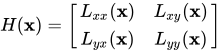
ハリスアフィン検出器は、 2次モーメント行列に対するハリスコーナー尺度を用いて複数のスケールで検出された特徴点に依存しています。ヘシアンアフィンもまた、複数のスケール反復アルゴリズムを使用して、スケールおよびアフィン不変点を空間的に特定および選択します。ただし、ヘシアンアフィン検出器は、各スケールにおいて、その点のヘシアン行列に基づいて特徴点を選択します。
どこは、方向とは、そして指示。重要なのは、導関数は現在の反復スケールで計算されるため、ガウスカーネルで平滑化された画像の導関数であるということです。ハリスアフィン領域検出器に関する記事で述べたように、導関数はガウスカーネルに関連する係数で適切にスケーリングする必要があります。。
各スケールにおいて、関心点は、ヘッセ行列の行列式とトレースの両方の局所極値を同時に示す点である。ヘッセ行列のトレースは、ガウスのラプラシアン(LoG)と同一である。[ 5 ]
As discussed in Mikolajczyk et al.(2005), by choosing points that maximize the determinant of the Hessian, this measure penalizes longer structures that have small second derivatives (signal changes) in a single direction.[6] This type of measure is very similar to the measures used in the blob detection schemes proposed by Lindeberg (1998), where either the Laplacian or the determinant of the Hessian were used in blob detection methods with automatic scale selection.
Like the Harris affine algorithm, these interest points based on the Hessian matrix are also spatially localized using an iterative search based on the Laplacian of Gaussians. Predictably, these interest points are called Hessian–Laplace interest points. Furthermore, using these initially detected points, the Hessian affine detector uses an iterative shape adaptation algorithm to compute the local affine transformation for each interest point. The implementation of this algorithm is almost identical to that of the Harris affine detector; however, the above mentioned Hessian measure replaces all instances of the Harris corner measure.
Mikolajczyk et al. (2005) have done a thorough analysis of several state of the art affine region detectors: Harris affine, Hessian affine, MSER,[7] IBR & EBR[8] and salient[9] detectors.[6] Mikolajczyk et al. analyzed both structured images and textured images in their evaluation. Linux binaries of the detectors and their test images are freely available at their webpage. A brief summary of the results of Mikolajczyk et al. (2005) follow; see A comparison of affine region detectors for a more quantitative analysis.
Overall, the Hessian affine detector performs second best to MSER. Like the Harris affine detector, Hessian affine interest regions tend to be more numerous and smaller than other detectors. For a single image, the Hessian affine detector typically identifies more reliable regions than the Harris-Affine detector. The performance changes depending on the type of scene being analyzed. The Hessian affine detector responds well to textured scenes in which there are a lot of corner-like parts. However, for some structured scenes, like buildings, the Hessian affine detector performs very well. This is complementary to MSER that tends to do better with well structured (segmentable) scenes.