
Loading article…
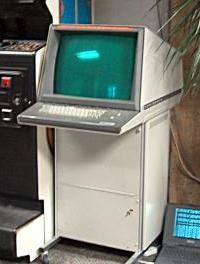
直視型双安定記憶管(DVBST )は、テクトロニクス社が自社の記憶管製品群を説明するために用いた略称である。これらは陰極線管(CRT)の一種で、CRTに固有のアナログ技術を用い、蛍光体スクリーンからの二次電子放出に基づいて書き込まれた情報を記憶する。その結果得られた画像は、CRT表面の連続的に光るパターンとして視認できた。
DVBST技術は、 1940年代後半に米国海軍研究所のアンドリュー・ヘフ、そしてウィリアムズとキルバーンによって予見されていた。テクトロニクスのロバート・H・アンダーソンは、1950年代後半にヘフの概念を改良し、信頼性が高くシンプルなDVSTを開発した。
DVBSTは、「フラッドガン」と「ライティングガン」という2つの電子銃を搭載しています。ライティングガンはワイヤーグリッドを走査し、グリッドを帯電させてネガティブ画像を生成します。次に、フラッドガンがグリッド全体に電子を照射します。既に帯電している領域は入射する電子を反発するため、電子は未帯電領域の蛍光体へのみ通過します。
その技術には、いくつかの利点と欠点があった。
テクトロニクス製のDVBSTは、アナログオシロスコープ(最初は564オシロスコープ、次にタイプ601モニター(1968年)、611モニター、7313および7514プラグインメインフレームオシロスコープ、いずれもテクトロニクス製)や、代表的なTek 4010とその後継機種であるTektronix 4014などのコンピュータ端末に使用されました。画面の一部は、従来の電子ビームガンによって個別に書き込まれ、広範囲の低速電子ガンによって「フラッディング」されます。消去するには、画面全体を明るい緑色の光で消去する必要があり、そのため「恐ろしい緑色の点滅マシン」というニックネームが付けられました。
DVBSTの一部の実装では、少量の動的に更新される非保存データの「書き込み」も可能だった。これにより、コンピュータ端末上にカーソルや作成中のグラフィック要素などを表示することが可能になった。
An alternate solution for storage tubes was the "dark trace" CRT, also known as the skiatron. This CRT replaced the conventional light-emitting phosphor layer on the face of the tube screen with a scotophor such as potassium chloride (KCl). KCl has the property that when a crystal is struck by an electron beam, that spot would change from translucent white to a dark magenta color. By backlighting such a CRT with a white or green circular fluorescent lamp, the resulting image would appear as black information against a green background or as magenta information against a white background. A benefit, aside from the semi-permanent storage of the displayed image, is that the brightness of the resultant display is only limited by the illumination source and optics.
The image would be retained until erased by flooding the scotophor with a high-intensity infrared light or by electro-thermal heating. Using conventional deflection and raster formation circuitry, a bi-level image could be created on the membrane and retained even when power was removed from the CRT. By using an array of dots, say 8 × 8, a larger pixel could be formed to represent 64 gray levels. One such device, the D36 Image Display, was made by DICOMED Corporation and a technical paper was presented at the 1972 Electro-Optical Conference in Geneva, Switzerland.