
Loading article…
Close-coupled cooling is an advanced cooling system particularly used in data centers. The goal of close-coupled cooling is to bring heat transfer as close to the source of heat as possible. Moving the air conditioner closer to the equipment rack, it ensures a more immediate capture of exhaust air and that the cool air goes exactly where it is needed.

Commercially available close-coupled solutions can be divided into two categories: open-loop and closed-loop.
Open-loop configurations are not totally independent of the room in which they are installed, and air flows interact with the surrounding conditions of the room.
Row-based air conditioning units are installed inside the rack's rows. Air flows generally follow short and linear paths, reducing the necessary power needed to start up the fans, therefore increasing energy efficiency.
A row-based cooling solution can be better than a single cooling system for the room, since it can be better adapted to the needs of cooling for specific rows.
A rear door heat exchanger type of solution substitutes the rear door of an existing rack with a heat exchange system.
These heat exchangers leverage the front-to-back pattern of energy loss present in most of the IT equipment: the servers dissipate warm air, which passes the heat exchanger coil and is returned to the room at a cooler temperature.
Because these cooling units do not take up additional space, they are particularly suitable either to cool all the spaces originally designed as data centers, or as a way to integrate an already existing cooling system.
Generally, a heat exchanger takes air from the ceiling into the cold aisle, and air vents in the ceiling follow air's natural flow; in close-coupled system cases, the units are positioned directly above the servers, making the cold air delivery and hot air return much more precise.
A system of this type, being positioned vertically, does not need floor space in the room.
The closed-loop cooling configurations act independently of the room in which they are installed; the rack and the heat exchanger work exclusively with one another, creating an internal microclimate.
The cooling system is next to the server rack and both of them are completely sealed; the solid doors on the enclosure and in-row air conditioners contain the air flow, directing cold air to the server inlet, and exhaust air through the cooling coil by using fans.
密閉型冷却システム設計により、ラックレベルでの非常に集中的な冷却が可能となり、外部環境を気にすることなく高密度なIT機器を設置することができるため、従来とは異なるスペースにも柔軟に機器を設置できます。
従来のレイアウトでは、ファンは部屋の周囲から空気を二重床の下を通って床タイルの穴からサーバーの吸気口へと送り込む必要があります。このプロセスにはエネルギーが必要で、その量はサーバーの構造によって異なります。多くの場合、二重床の下にはケーブル束や配管などの障害物があり、必要な冷気量を送るためにファンに追加のエネルギーが必要になります。
近接配置型ソリューションでは、冷却システムと機器ラックが近接しているため、必要なエネルギーが削減されます。インロー型では、冷却ユニットがラックの列に組み込まれ、ラックに直接空気を供給するため、床下には考慮すべき障害物がありません。近接配置型システムを導入した場合、同等の冷却能力を持つ従来のCRACシステムと比較して、年間エネルギー消費量を最大95%削減できると推定されています。
冷却方式によっては、負荷やラック内部の温度に応じて回転速度を調節できる可変速ファンを採用しているものもあります。データセンターの要件を満たす最小回転速度で動作するファンを使用することで、エネルギー消費量の削減にもつながります。
風量の減少に対して、節約できるエネルギーの割合が比例以上に増加することが確認されています(例えば、ファンの速度を10%下げると、エネルギーを27%節約できます)。
密結合型ソリューションの販売は爆発的に増加すると予想されていたにもかかわらず、最近の研究では成長が鈍化していることが示されている。その理由は、ラックが8~10kWの 閾値に達した場合にのみ、インロー型ソリューションが大幅な省エネルギー効果を発揮するのに対し、現在の中規模データセンターの平均密度は約5kWであり 、省エネルギー効果は冷却システムへの投資コスト増に見合うものではないためと考えられる。
従来のシステムでは、冷水供給温度は通常6~7℃の間で変動し、冷たい吸気と熱い排気が相互作用するため、冷気を生成するには冷水が必要です。しかし、 ASHRAEの規定に従い、吸気温度を18~26.5℃ に保つ必要があります。
密結合型システムの中には、冷凍システムが近接していることや冷却コイルの設計により、ASHRAEのガイドラインの範囲内で、より高い給水温度を許容するものがあります。
データセンターのエネルギー消費量の30~40%は冷蔵庫によるものであり、そのエネルギー消費量の大部分は機械式冷凍によるものであるため、給水温度を高くすることで、自然冷却が可能な時間を延ばすことができ、結果として冷蔵庫の効率を高めることができる。
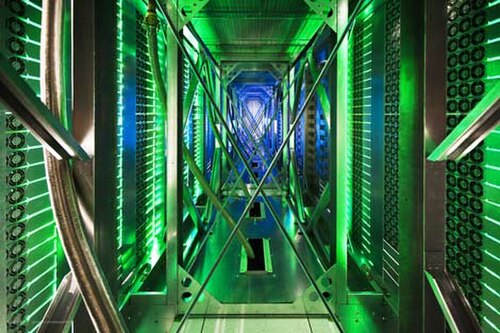
2016年のインタビューで、Googleのデータセンター担当副社長ジョセフ・カバ氏は、同社はデータセンターの冷却システムを12~18ヶ月ごとに再構築しており、密結合システムに注力していると述べた。[ 1 ]
データセンターでは、床は二重構造になっているが、穴あきタイルは使用されていない。冷却は、両側にラックが並ぶ閉鎖された通路で行われ、冷水を使用する冷却コイルがこれらの暖かい通路の天井として機能し、建物の別の場所に設置された冷却塔との間で水を運ぶ配管も収容している。
空気の温度は一般的に26.5 ℃前後に保たれていますが、 様々な部品との接触により徐々に上昇し、約49℃まで達します。暖かい密閉された通路内でファンによって送られた空気は、部屋の上部に到達した後、冷却コイルを通過して室温まで冷却されます。その後、フレキシブル配管が高温通路上部の冷却コイルに接続され、床の開口部を通って下降し、二重床の下を流れます。
Kava社の「配管に漏れがあった場合、水は二重床に流れ込みます。この設計には豊富な経験があり、これまで大規模な水漏れは一度も発生していません」という発言から、水漏れに対する緊急システムが存在することが確認されました。また、サーバーの近くに液体があることも問題視されていないことも確認されました。
カバ氏はまた、天井に設置された装置で高温の排気を二重床エリアの周囲に配置されたコンピュータ室の空調機(CRAC)に戻すタイプの他の冷却システムについて言及し、「高温の空気がCRACに向かって移動する際に長距離を移動するため、このシステムは非効率的である。一方、密結合型システムははるかに効率的である」と述べた。