
Loading article…
| Windows CardSpace | |
|---|---|
 | |
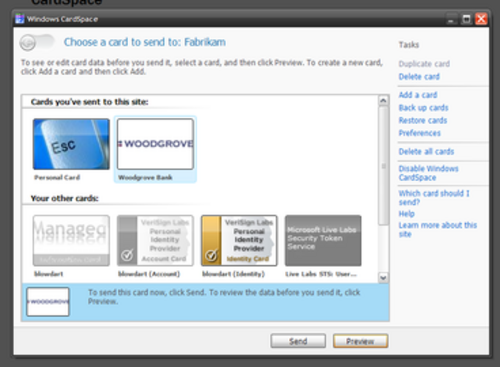 Windows版CardSpaceのユーザーインターフェース(カード作成テンプレートの例を表示) | |
| 開発者 | マイクロソフト |
| オペレーティング·システム | マイクロソフトWindows |
| 後継 | U-Prove |
| サービス名 | Windows CardSpace ( idsvc ) |
| タイプ | 本人確認管理システム |
Windows CardSpace (コードネームInfoCard ) は、Microsoftが提供していたものの現在は提供が終了しているID セレクターアプリです。ユーザーのデジタル IDへの参照を保存し、視覚的な情報カードとして表示します。CardSpace は、これらの ID が受け入れられるアプリケーションや Web サイトにおいて、ユーザーがこれらの ID を簡単かつ安全に使用できるように設計された一貫したUI を提供します。フィッシング攻撃への耐性と、 Kim Cameronの「アイデンティティの 7 つの法則」[ 1 ]への準拠が、その設計上の目標でした。[ 2 ]
CardSpaceはWindows 7およびWindows Vistaに組み込まれたコンポーネントであり、.NET Framework 3.xパッケージの一部としてWindows XPおよびWindows Server 2003でも利用可能になっています。
情報カード対応のアプリケーションやウェブサイトがユーザーに関する情報を取得しようとする場合、特定のクレームセットを要求します。するとCardSpaceのユーザーインターフェースが表示され、表示がCardSpaceサービスに切り替わります。CardSpaceサービスでは、ユーザーの保存されたIDがビジュアルカードとして表示されます。ユーザーが使用するカードを選択すると、CardSpaceソフトウェアはIDの発行者に接続し、要求された情報を含むデジタル署名付きXMLトークンを取得します。CardSpaceでは、ユーザーが個人用(自己発行とも呼ばれる)情報カードを作成することもできます。このカードには、氏名や住所など、14項目のID情報のうち1つ以上を含めることができます。その他の取引では、管理情報カードが必要になる場合があります。これは、銀行、雇用主、政府機関など、個人に代わってクレームを行う第三者のIDプロバイダーによって発行されます。
Windows CardSpace is built on top of the Web services protocol stack, an open set of XML-based protocols, including WS-Security, WS-Trust, WS-MetadataExchange and WS-SecurityPolicy. This means that any technology or platform that supports these protocols can integrate with CardSpace. To accept information cards, a web developer needs to declare an HTML<OBJECT> tag that specifies the claims the website is demanding and implement code to decrypt the returned token and extract the claim values. If an identity provider wants to issue tokens, it must provide a means by which a user can obtain a managed card and provide a Security Token Service (STS) which handles WS-Trust requests and returns an appropriate encrypted and signed token. During the 2000s, identity providers that didn't wish to build STS could obtain one from a variety of vendors, including PingIdentity, BMC, Sun Microsystems, Microsoft, or Siemens.
Because CardSpace and the identity metasystem upon which it is based are token-format-agnostic, CardSpace did not compete directly with other Internet identity architectures like OpenID and SAML. These three approaches to identity can be seen as complementary,[3] because during the 2000s, information cards could be used today for signing into OpenID providers, Windows Live ID accounts, and SAML identity providers.
IBM and Novell planned to support[4] the Higgins trust framework to provide a development framework that includes support for information cards and the Web services protocol stack, thus including CardSpace within a broader, extensible framework also supporting other identity-related technologies, such as SAML and OpenID.
Microsoft initially shipped Windows CardSpace with the .NET Framework 3.0, which runs on Windows XP, Windows Server 2003, and Windows Vista. It is installed by default on Windows Vista as well as Windows 7 and is available as a free download for XP and Server 2003 via Windows Update. An updated version of CardSpace shipped with the .NET Framework 3.5. The new Credential Manager in Windows 7 uses Windows CardSpace for the management and storage of saved user credentials.[5]
2011年2月15日、マイクロソフトはWindows CardSpace 2.0を出荷しないことを発表した。[ 6 ]マイクロソフトはその後、 U-Proveと呼ばれる代替製品の開発に取り組んだ。[ 7 ]