
Loading article…

図1を参照すると、AC-ACコンバータは以下のように分類できる。

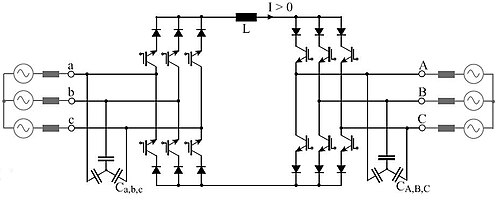
DCリンクを備えたコンバーターには2種類あります。
モータに必要な動的制動動作は、整流器に接続された制動用DCチョッパと抵抗シャントによって実現できる。あるいは、整流器部に逆並列サイリスタブリッジを設けて、交流線路にエネルギーを回生させることもできる。ただし、このような位相制御サイリスタを用いた整流器は、ダイオードを用いた整流器に比べて、低負荷時の交流線路歪みが大きく、力率も低くなる。
入力電流がほぼ正弦波状で双方向電力の流れを持つAC-ACコンバータは、パルス幅変調(PWM)整流器とPWMインバータをDCリンクに接続することで実現できる。DCリンクの電力は、両段に共通するエネルギー蓄積素子によって供給される。このエネルギー蓄積素子は、電圧DCリンクの場合はコンデンサC、電流DCリンクの場合はインダクタLである。PWM整流器は、対応するAC線間電圧と同相または逆相(エネルギーフィードバックのため)の正弦波AC線間電流が流れるように制御される。
Due to the DC-link storage element, there is the advantage that both converter stages are to a large extent decoupled for control purposes. Furthermore, a constant, AC line independent input quantity exists for the PWM inverter stage, which results in high utilization of the converter’s power capability. On the other hand, the DC-link energy storage element has a relatively large physical volume, and when electrolytic capacitors are used, in the case of a voltage DC-link, there is potentially a reduced system lifetime.
A cycloconverter constructs an output, variable-frequency, approximately sinusoid waveform by switching segments of the input waveform to the output; there is no intermediate DC link. With switching elements such as SCRs, the output frequency must be lower than the input. Very large cycloconverters (on the order of 10 MW) are manufactured for compressor and wind-tunnel drives, or for variable-speed applications such as cement kilns.
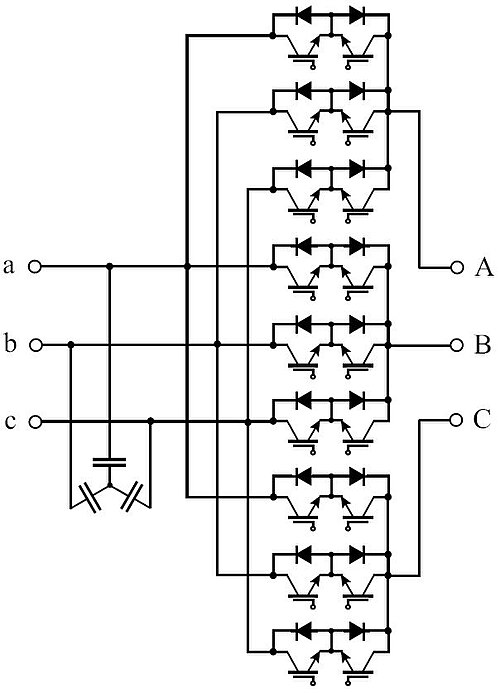

In order to achieve higher power density and reliability, matrix converters are considered. They achieve three-phase AC-AC conversion without any intermediate energy storage element. Conventional direct matrix converters (Fig. 4) perform voltage and current conversion in one single stage.
There is the alternative option of indirect energy conversion by employing the Indirect Matrix Converter (Fig. 5) or the Sparse matrix converter which was invented by Prof. Johann W. Kolar from the ETH Zurich. As with the DC-link based VSI and CSI controllers (Fig. 2 and Fig. 3), separate stages are provided for voltage and current conversion, but the DC-link has no intermediate storage element. Generally, by employing matrix converters, the storage element in the DC-link is eliminated at the cost of a larger number of semiconductors. Matrix converters are often seen as a future concept for variable speed drives technology, but despite intensive research over the decades they have until now only achieved low industrial penetration. However, citing recent availability of low-cost, high performance semiconductors, one larger drive manufacturer has over past few years been actively promoting matrix converters.[11][12]