
Loading article…
SequoiaDB is a multi-model NewSQL database.
SequoiaDB provides distributed NewSQL, distributed file system and object storage, and high-performance NoSQL storage modes, corresponding to distributed online transactions, unstructured data and content management, as well as massive data management and high performance access scenarios.
SequoiaDB's first release is in 2013, SequoiaDB was open-source in December 2014. The latest release of SequoiaDB is v3.0.
In 2017 and 2018, SequoiaDB is listed in Gartner's database report, and is the first Chinese database vendor listed.[1]
SequoiaDB database engine is under GNU Affero General Public License (AGPL V 3.0) license, and the clients, drivers and connectors are under Apache License V2.0.[2]
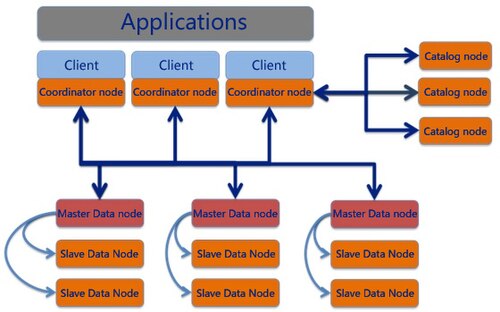
SequoiaDB applies distributed structure.[3] In a client terminal (or an application terminal), local or/and remote applications are linked to SequoiaDB client library. Local or/and remote applications communicate with catalog node under TCP/IP protocol. Catalog node doesn't store any user data. It is only a node that receive requests and distribute them to target data nodes. Coord node store system metadata information. Coord nodes get the location of data on data nodes by communicating with catalog nodes. Data nodes are used to store users' data information.
SequoiaDB 3.0 uses a "Storage-SQL" architecture, which SQL layer and storage engine layer are independent of each other, similar architectures also appear on many new-generation distributed databases such as AWS's Aurora.
Transactions and ACID: SequoiaDB provide full ACID support and transactions cross nodes/clusters. ACID is the basis of a transactional database. SequoiaDB 3.0 has fully supported ACID and 100% support atomicity, consistency, isolation, and durability (ACID).
Standard SQL Support: SequoiaDB provides a distributed SQL engine plugin called SequoiaSQL, which supports standard SQL-2003 and MySQL/PostgreSQL both on syntax and protocol level.
Multi-Model: SequoiaDB supports both relational(structured), object data (unstructured) and JSON (semi-structured) data at the same time. For storage engine, SequoiaDB uses JSON document-oriented data storage model. JSON-based storage is perfect for integrating the heterogeneous data within the enterprise provides a standard way.
HTAP:運用DBMSは進化を続けており、革新的な新規参入企業や既存企業がDBMS内分析機能をサポートしています。SequoiaDBはSparkコネクタを備えており、Sparkと統合できます。Sparkのデータソースとして使用でき、Spark SQLをサポートします。
ディザスターリカバリー:SequoiaDBはMPPアーキテクチャを採用し、GDPSをネイティブにサポートします。顧客の高可用性要件に基づいて柔軟に展開できます。SequoiaDBはネットワーク容量に応じてアクティブ/アクティブ構成のデータセンターをサポートします。同一都市内のデュアルデータセンターへのSequoiaDBの展開は問題なく動作します。しかし、データセンターが遠く離れている場合、例えば異なる都市にある場合は困難です。
SequoiaDBは、 C、C++、C#、Java、PHP、Pythonなど、多くのプログラミング言語をサポートしています。[ 4 ]