Loading article…
In theoretical computer science, multiparty communication complexity is the study of communication complexity in the setting where there are more than two players.
In the traditional two-party communication game, introduced by Yao (1979),[1] two players, P1 and P2 attempt to compute a Boolean function
Player P1 knows the value of x2, P2 knows the value of x1, but Pi does not know the value of xi, for i = 1, 2.
In other words, the players know the other's variables, but not their own. The minimum number of bits that must be communicated by the players to compute f is the communication complexity of f, denoted by κ(f).
The multiparty communication game, defined in 1983,[2] is a powerful generalization of the two-party case: Here the players know all the others' input, except their own. Because of this property, sometimes this model is called "numbers on the forehead" model, since if the players were seated around a round table, each wearing their own input on the forehead, then every player would see all the others' input, except their own.
The formal definition is as follows: players: intend to compute a Boolean function
On set of variables there is a fixed partition of classes , and player knows every variable, except those in , for . The players have unlimited computational power, and they communicate with the help of a blackboard, viewed by all players.
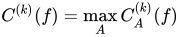
The aim is to compute ), such that at the end of the computation, every player knows this value. The cost of the computation is the number of bits written onto the blackboard for the given input and partition . The cost of a multiparty protocol is the maximum number of bits communicated for any from the set {0,1}n and the given partition . The -party communication complexity, of a function , with respect to partition , is the minimum of costs of those -party protocols which compute . The -party symmetric communication complexity of is defined as
where the maximum is taken over all k-partitions of set .
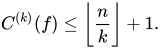
2人以上のプレイヤーに対する一般的な上限として、A 1 が分割A 1 , A 2 ,..., A kの最小クラスの 1 つであると仮定します。すると、P 1 は| A 1 | + 1 ビットの通信でSの任意のブール関数を計算できます。P 2 はA 1 の | A 1 | ビットを黒板に書き、 P 1はそれを読み取り、値を計算して発表します。 したがって、以下のように記述できます。
一般化内積関数(GIP)[ 3 ]は次のように定義されます。なれ-ビットベクトル、そしてになるタイムズ行列、列としてベクトル。は、行列のすべて1の行の数です。、法 2 で計算します。言い換えると、ベクトルが特性ベクトルに対応するのサブセット要素の基本セットの場合、GIP はこれらの共通部分のパリティに対応します部分集合。
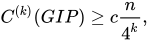
[ 3 ]は、
定数c > 0 とする。
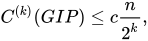
GIPのマルチパーティ通信複雑性の上限は[ 4 ]で示されている。
定数c > 0 とする。
一般的なブール関数fの場合、そのL 1ノルム[ 5 ]を使用して、fのマルチパーティ通信の複雑さを次のように制限できます。 [ 6 ]
擬似乱数発生器の構築は、GIP関数のBNS下限に基づいて行われた。[ 3 ]