
Loading article…
Coloured squadrons of the Royal Navy[1] were first introduced in the Tudor Period during the reign of Queen Elizabeth I of England (1558–1603). The purpose was to separate the English fleet into three squadrons for better command and control, though in 1596 there were four squadrons. In 1620, as the fleet was expanding, the system was changed to include three squadrons but also three sub-divisions. Assigned to each of these squadrons were flag officers who were separated in terms of their seniority by the use of coloured flags; in effect, the squadrons provided a system of designating the nine or ten most senior admirals of the Royal Navy until the system was abolished in 1864.[2]Squadrons and divisions continued to be used as the system of managing large formations when the British navy consisted of more than one fleet for most of the twentieth century, until 1971.[3]
Historically, the English fleet was first divided into three squadrons distinguished by colour in 1558, the Admiral of the English fleet, the Lord Admiral of England's squadron, flew a plain red flag as its ensign. The Vice-Admiral of the fleet, or Vice-Admiral of England, flew a plain blue flag, and the Rear-Admiral of the fleet flew a plain white flag. The order of precedence until May 1596 was red; blue; and white.[4]
In June 1596 the English fleet was divided into four squadrons for the expedition for the Capture of Cádiz. The fleet during this expedition had joint commanders-in-chief styled as "Joint Generalls of the Armies by Sea and Land". Naval forces were under the command of the Lord Admiral of England, Charles Howard, 1st Earl of Nottingham, whose squadron was in the centre, whilst land forces were under the command of the General of the Army, Robert Devereux, 2nd Earl of Essex, whose squadron was also in the centre. The van squadron, or front, was commanded by the Vice Admiral of the Fleet (Vice-Admiral of England). The rear squadron (called the wyng) was commanded by the Rear-Admiral of the Fleet. After this expedition the system returned to a three squadron fleet.[4]
In 1620 these squadrons had grown to the point where they could not be managed effectively by one admiral alone. This led to the introduction of a new system whereby squadrons were further subdivided into three subdivisions, each then led by three admirals of different ranks. Admiral was the senior rank, followed by Vice-Admiral and Rear-Admiral. In 1620 flag ranks were formally established in terms of promotion.[5] From 1620 until 1652 the order of precedence of the squadrons was Red, Blue and White, until 1653, when the order of precedence was changed to red, white, and blue. In 1688 the permanent rank of Admiral of the Fleet was created, replacing the Lord High Admiral England operationally as commander-in-chief.[4]
In 1805, after the Battle of Trafalgar, the rank of Admiral of the Red was introduced. It became the highest rank that an Admiral could attain until 1862, when an allowance was made for more than one Admiral of the Fleet to be appointed. In 1864 the colour squadron organisation was abolished and the Royal Navy adopted the White Ensign of the former White Squadron. The Red Ensign of the Red Squadron became the ensign of the British Merchant Navy, and the Blue Ensign of the Blue Squadron became the ensign of the Auxiliary Fleet.[4][6]
Included:[4]



During expedition to capture Cadiz with the aid of the Dutch (in 1 squadron) in June 1596 the English fleet was divided into four squadrons which had joint commanders in chief. Naval forces were commanded by the Lord Admiral whilst land forces were commander by the General of the Army each allocated corresponding flags to differentiate them as shown below.[4]
Included:[4]


Included:[4]

Included:[4]

Included:[4]
Included:[4]


最上位(赤色)戦隊は通常、戦列の中央に配置され、常に艦隊司令長官(当初は英国提督、後に1688年に艦隊提督の階級が創設されるまで提督卿と呼ばれた)によって率いられた。この期間、彼の前衛部隊は英国副提督(赤色)によって、後衛部隊は英国少将(赤色)によって率いられた。1688年からは、艦隊提督の前衛部隊は赤色副提督によって、後衛部隊は赤色少将によって率いられた。1805年に赤色提督の階級が創設されたが、前衛と後衛の指揮は変わらなかった。[ 7 ]
含まれるもの:[ 4 ]


第二位にランクされ、通常は先頭に配置される白戦隊は、白提督によって指揮され、その下位部隊は白中将(先頭)と白少将(後部)によって率いられる。[ 7 ]
含まれるもの:[ 4 ]


3番目または下位の青艦隊も同様に、提督、中将、少将が指揮し、それぞれが青い旗を掲げていた。[ 7 ]

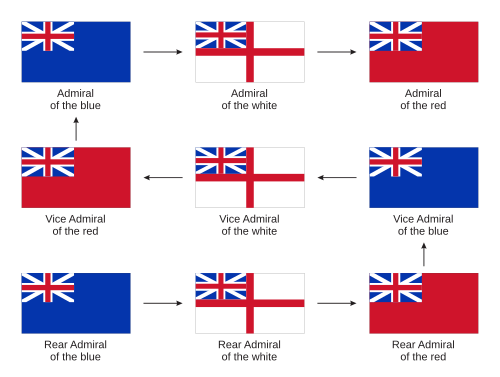
提督の昇進もこの順序で行われた。青艦隊の少将は昇進すると、最初の旗艦昇進として白艦隊の少将になった。赤艦隊の少将に達すると、次の昇進で青艦隊の副提督になり、最終的に白艦隊の提督になるまで、このように昇進が続いた。階級制度が守られなかったのは赤艦隊だけであった。1805年に赤艦隊の階級が導入されるまでは、赤艦隊の提督は存在しなかった。これは、赤艦隊の提督が艦隊全体の指揮を執っているとみなされたためである。1862年までは、艦隊の提督は1人しか存在できなかった。[ 4 ] [ 7 ]
{{cite book}}: CS1メンテナンス: パブリッシャーの場所 (リンク)